
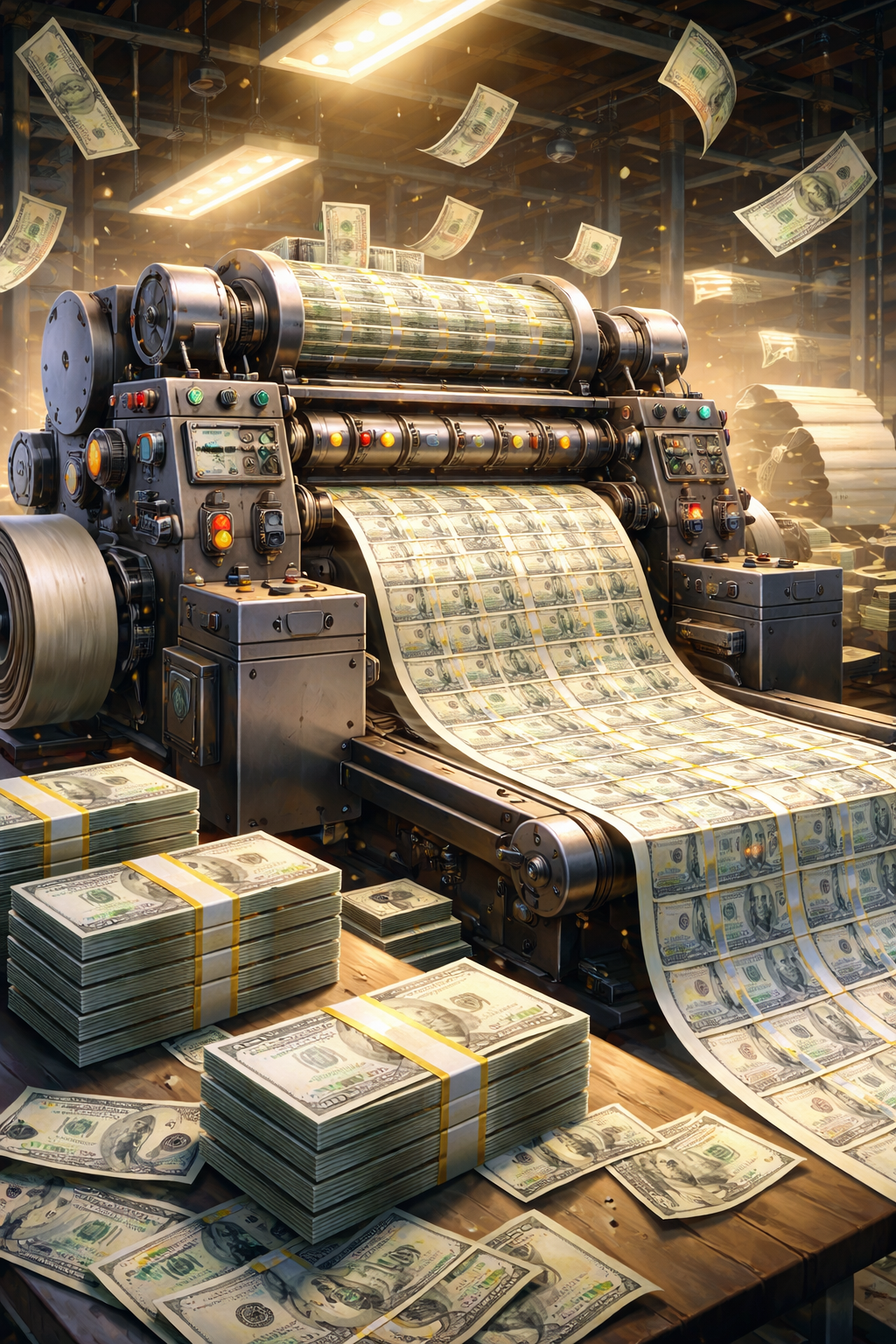
Printing money refers to the process by which a country increases the amount of money available in its economy. In modern systems, this rarely involves physically producing cash. Instead, central banks create new money digitally through banking and financial mechanisms. Printing money increases liquidity, but it does not automatically increase goods, services, or real economic value.
Money creation is managed by central banks to support economic stability, control inflation, and maintain trust in the currency. When printing money is done carefully and in limited amounts, it can help stabilize economies during slowdowns. When done excessively, it creates economic imbalances.
Summary Box
- Printing money increases currency supply
- Most money is created digitally, not as cash
- Value depends on economic output, not quantity
Key Takeaways
- Money creation ≠ wealth creation
- Central banks control the process
- Limits are essential for stability
Why Printing Money Seems Like an Easy Solution
At first glance, printing money looks like a simple way to solve economic problems. Governments appear able to create funds to pay debts, support public services, or stimulate growth without raising taxes. This creates the impression that financial shortages can be fixed instantly.
The idea is appealing because money is often mistaken for real wealth. In reality, wealth comes from production, labor, and resources. Printing money only increases the amount of currency, not the availability of goods or services. When this distinction is ignored, economic risks increase.
Many people also assume that modern digital systems remove limits on money creation. While technology makes the process faster, economic constraints still apply. Demand, supply, and productivity continue to determine real value.
Summary Box
- Appears to solve funding problems quickly
- Confuses money with real wealth
- Ignores production limits
Key Takeaways
- Money creation feels easy but has consequences
- Wealth depends on goods and services
- Economic limits still exist
ALSO READ : What Is Inflation?
How Printing Money Causes Inflation
Printing money causes inflation when the amount of money grows faster than the supply of goods and services. When more currency enters the economy, people have greater spending power, but if production does not increase at the same pace, prices begin to rise.
As demand increases, businesses respond by charging higher prices rather than increasing output immediately. Over time, this leads to a general rise in price levels, not just isolated price increases. The real value of money declines because each unit can buy less than before.
Another key factor is expectations. When people believe that prices will continue rising due to ongoing printing money, they adjust behavior by spending quickly or demanding higher wages. This behavior further fuels inflation and makes it harder to control.
Summary Box
- More money increases demand
- Limited supply leads to higher prices
- Expectations can accelerate inflation
Key Takeaways
- Inflation results from demand–supply imbalance
- Price levels rise, not real wealth
- Expectations reinforce inflation
Impact on Purchasing Power
Printing money affects purchasing power by reducing the real value of currency over time. When more money circulates in the economy without a matching increase in goods and services, prices rise. As a result, the same amount of money buys fewer products than before.
Even if incomes increase, they often do not keep pace with rising prices. This gap lowers real income and weakens savings. Households on fixed incomes are especially affected because their earnings remain constant while living costs increase.
The long-term effect of printing money is a gradual erosion of financial stability. Savings lose value, planning becomes difficult, and consumer confidence declines when purchasing power continues to fall.
Summary Box
- Higher prices reduce money’s real value
- Income growth often lags behind inflation
- Savings lose purchasing strength
Key Takeaways
- Purchasing power declines as prices rise
- Fixed-income earners are most affected
- Stable money preserves economic confidence
Effect on Currency Value and Trust
Printing money can weaken a currency when it is done excessively or without economic backing. As the supply of money increases faster than economic output, the currency’s value declines. This means it takes more units of the same currency to buy goods, services, or foreign currencies.
Trust is central to how money functions. People accept money because they believe it will retain value over time. When printing money becomes frequent or uncontrolled, confidence erodes. Individuals and businesses may shift toward foreign currencies, assets, or commodities, which further pressures the domestic currency.
Loss of trust also affects exchange rates. A weaker currency raises the cost of imports, increases inflation, and creates a cycle that is difficult to reverse. Maintaining trust requires disciplined monetary management and predictable policy.
Summary Box
- Currency value falls when supply rises excessively
- Trust determines money’s acceptance
- Exchange rates react to confidence levels
Key Takeaways
- Money depends on public trust
- Excess supply weakens currency value
- Stability supports long-term confidence
Printing Money vs Economic Growth
Printing money and economic growth are often confused, but they are fundamentally different. Economic growth comes from higher productivity, innovation, investment, and efficient use of resources. It reflects an increase in the real output of goods and services within an economy.
Printing money, by contrast, only increases the amount of currency in circulation. It does not build factories, improve skills, or create technology. Without real production growth, additional money simply redistributes existing value rather than creating new value.
Sustainable growth depends on factors such as education, infrastructure, capital formation, and technological progress. When money creation is not supported by these factors, it leads to higher prices instead of higher living standards.
Summary Box
- Growth comes from real output
- Money creation does not increase productivity
- Value depends on goods and services
Key Takeaways
- Economic growth cannot be created by currency alone
- Productivity drives long-term prosperity
- Money must reflect real economic capacity
Historical Evidence of Excessive Money Creation
History provides clear examples of what happens when printing money is used excessively without supporting economic output. In several cases, rapid expansion of the money supply led to extreme inflation, loss of savings, and economic collapse.
When governments relied heavily on printing money to cover deficits or finance spending, prices rose uncontrollably. As inflation accelerated, wages failed to keep up, basic goods became scarce, and normal trade broke down. Money stopped functioning as a reliable store of value.
These historical cases show that once confidence in a currency is lost, restoring stability becomes extremely difficult. Economic recovery usually required strict monetary controls, fiscal discipline, and structural reforms rather than further money creation.
Summary Box
- Excess money supply led to severe inflation
- Savings and wages lost real value
- Economic stability collapsed
Key Takeaways
- History shows clear limits to money creation
- Confidence is hard to rebuild once lost
- Long-term stability requires discipline
When Governments Do Use Money Creation
Governments may allow limited printing money during extraordinary economic conditions, such as recessions, financial crises, or emergencies. The purpose is not to create wealth, but to stabilize the economy when normal financial mechanisms are under stress.
Central banks usually apply this approach through controlled tools like emergency lending or large-scale asset purchases. These measures aim to maintain liquidity, prevent bank failures, and support essential economic activity. Strict limits are used to reduce long-term inflation risks.
The success of such actions depends on timing, scale, and exit strategy. If money creation continues after conditions improve, it can fuel inflation and weaken confidence. This is why central banks gradually withdraw excess liquidity once stability returns.
Summary Box
- Used only in exceptional situations
- Managed by central banks, not governments directly
- Temporary by design
Key Takeaways
- Money creation can stabilize crises
- Controls and limits are essential
- Long-term use increases inflation risk
Common Misconception
- Printing money is safe if used repeatedly ❌
Common Misconceptions About Printing Money
Many misunderstandings exist around how printing money works and what it actually does to an economy. These misconceptions often oversimplify complex monetary systems and ignore real economic constraints.
Printing Money Creates Wealth
A common belief is that creating more currency makes a country richer. In reality, wealth depends on goods, services, productivity, and resources. Printing money only changes the amount of currency in circulation, not the real value of the economy.
Digital Money Has No Limits
Some assume that because modern money is digital, it can be created endlessly without consequences. While technology makes money creation easier, economic limits still apply. Excess supply can still reduce value and trigger inflation.
Inflation Happens Immediately
Another misconception is that inflation appears instantly after printing money. Inflation often develops gradually, depending on demand, supply, expectations, and how long money creation continues.
Only Poorly Managed Economies Face Problems
Inflation from printing money is not limited to weak economies. Any country can face risks if money creation is excessive and not aligned with economic output and policy discipline.
Summary Box
- Money is not the same as wealth
- Digital systems do not remove economic limits
- Inflation depends on multiple factors
Key Takeaways
- Economic value comes from production
- Limits exist regardless of technology
- Stability depends on disciplined policy
Common Misconception
- Printing money has no long-term consequences ❌
Conclusion: Why Printing Money Isn’t the Solution
In simple terms, printing money does not create real economic value. While it may seem like an easy fix for financial problems, it only increases the amount of currency, not the production of goods and services. When money grows faster than the economy, prices rise and purchasing power falls.
Controlled printing money can help during emergencies, but long-term reliance leads to inflation, currency weakness, and loss of public trust. That’s why stable economies focus on productivity, investment, and sound policies instead of unlimited money creation.
The key lesson is clear: economic strength comes from real growth, not from printing more currency.
FAQs: Why Can’t We Print Money?
What happens if a country starts printing money too much?
Excessive printing money increases currency supply without increasing production. This reduces purchasing power and often leads to inflation, making everyday goods more expensive.
Can printing money solve poverty or debt?
No. Printing money does not create jobs, resources, or productivity. Long-term poverty reduction requires economic growth, education, and stable policies—not extra currency.
Why don’t rich countries rely on printing money?
Even strong economies avoid excessive printing money because it can damage trust, weaken currency value, and disrupt price stability in the long run.
Is digital money safer than printing cash?
Digital systems still follow the same rules. Printing money, whether physical or digital, can cause inflation if it grows faster than economic output.
Has printing money ever worked successfully?
Limited printing money during crises can help stabilize economies. However, success depends on strict control and timely withdrawal once conditions improve.
Who controls money printing in a country?
Central banks manage printing money, not governments directly. Their goal is to maintain inflation control and economic stability.
REFRENCES :
International Monetary Fund (IMF)
World Economic Outlook Reports – Inflation dynamics, money supply, and monetary policy frameworks.
Source: International Monetary Fund publications
World Bank
Understanding Inflation and Money Supply – Explains how excess money creation affects prices and economic stability.
Source: World Bank economic research
 Who Can