
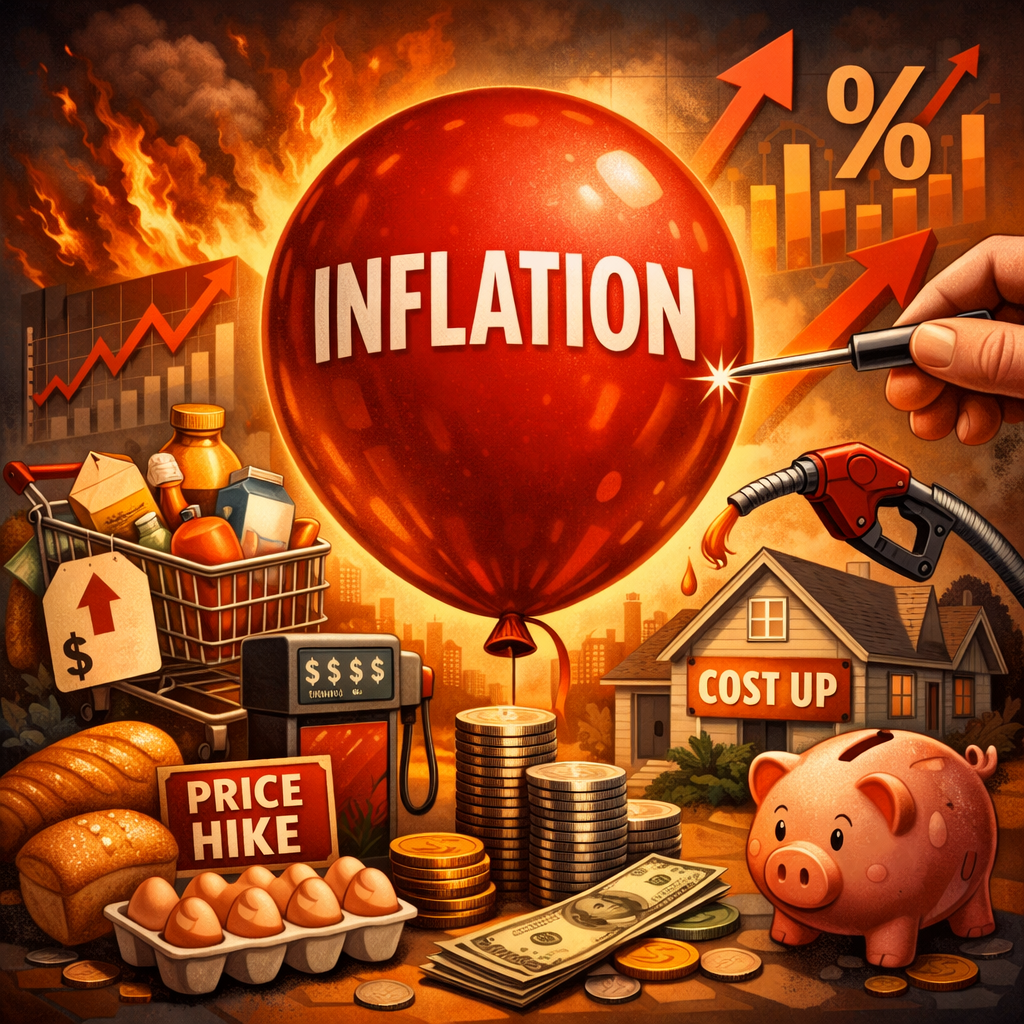
Inflation is the sustained increase in the general price level of goods and services over time, resulting in a decline in the purchasing power of money. When rises, each unit of currency buys fewer goods and services than before, meaning money loses real value.
Inflation vs. Price Increase
A price increase refers to the rise in the cost of a specific product or service, while inflation reflects a broad-based, economy-wide trend affecting most prices simultaneously over a sustained period. Temporary price changes do not qualify as inflation unless they persist and spread across sectors.
How Inflation Affects Purchasing Power
It reduces purchasing power by increasing prices faster than income growth. If wages do not rise at the same pace as inflation, consumers can afford fewer goods and services, lowering real income and savings value over time.
Key Facts
- It measures overall price level changes, not individual price movements
- It reflects systemic economic conditions, not short-term market fluctuations
- Purchasing power declines when inflation rises faster than income growth
Summary Box
Inflation is a long-term economic condition where prices rise across an economy, reducing the real value of money and weakening purchasing power.
Key Takeaways
- It is persistent and economy-wide
- It differs from isolated price hikes
- Purchasing power declines as inflation increases
Common Misconceptions
- It means all prices rise equally ❌
- It is the same as cost-of-living increases ❌
- It happens overnight ❌
ALSO READ : How to Manage Pocket Money
Why Does Inflation Happen?
Price increases occur when the balance between money, demand, and supply in an economy is disrupted, leading to broad and lasting cost pressures. This outcome is not caused by a single factor but by several economic forces working together
Demand-Pull Inflation
Demand-pull price pressure arises when overall demand for goods and services exceeds an economy’s production capacity.
Key mechanisms:
- Increased consumer spending
- Rising incomes and employment
- Expansionary fiscal or monetary policies
When demand grows faster than supply, businesses respond by raising prices, leading to inflationary pressure.
Cost-Push Inflation
Cost-push price pressure occurs when production expenses rise, leading businesses to increase prices to protect margins.
Common cost drivers:
- Higher wages
- Rising energy and fuel prices
- Increased raw material costs
- Supply chain disruptions
These higher costs are passed on to consumers, contributing to sustained inflation.
Built-In Inflation (Wage–Price Spiral)
Built-in price growth is influenced by expectations about future costs. When workers believe prices will increase, they often ask for higher wages. Employers may then raise prices to offset higher labor expenses, which can create a repeating cycle of rising costs.
Role of Money Supply
It can occur when money supply grows faster than economic output. Excess liquidity increases spending power without a matching increase in goods and services, pushing prices upward.
(Central banks closely monitor money supply growth to maintain price stability.)
Key Points
- It occurs when demand exceeds supply
- Rising production costs directly increase prices
- It expectations can reinforce future inflation
- Excess money supply amplifies price pressures
Summary Box
It happens due to excess demand, rising production costs, expanding money supply, and inflation expectations, all of which weaken the purchasing power of money over time.
Key Takeaways
- It is multi-causal, not single-factor driven
- Both consumer behavior and production costs matter
- Expectations play a critical role in sustaining inflation
Pros / Cons
Pros
- Encourages spending and investment at moderate levels
- Signals economic growth
Cons
- Reduces purchasing power
- Erodes savings and fixed incomes
Common Misconceptions
- It is caused only by printing money ❌
- It always indicates economic growth ❌
- Higher prices automatically mean inflation ❌
Role of Money Supply in Inflation
Money supply plays a central role in inflation because it determines how much spending power exists in an economy. When the supply of money grows faster than the production of goods and services, prices tend to rise across the economy.
How Money Supply Influences Prices
Money supply refers to the total amount of currency and liquid financial assets available in an economy. When more money circulates without a corresponding increase in output, consumers and businesses compete for the same goods, pushing prices upward.
(Based on standard monetary economics principles.)
Central Banks and Monetary Policy
Central banks regulate money supply through monetary policy tools, including:
- Interest rate adjustments
- Open market operations
- Reserve requirements
Lower interest rates and expansionary policies increase borrowing and spending, which can stimulate economic growth but also raise inflation risks if prolonged.
Money Supply Growth vs Economic Output
It pressure emerges when:
- Money supply expands rapidly
- Economic productivity remains unchanged or grows slowly
This imbalance weakens purchasing power and results in sustained inflation rather than temporary price increases.
Key Facts
- It rises when money supply grows faster than output
- Central banks manage inflation through interest rates and liquidity control
- Excess liquidity increases aggregate demand and price levels
Summary Box
An expanding money supply can contribute to rising prices when extra liquidity boosts spending without a corresponding increase in production, resulting in broad and lasting cost pressures.
Key Takeaways
- Money supply directly affects purchasing power
- Central banks play a critical role.
- It is more likely when money growth exceeds economic growth
Pros / Cons of Expanding Money Supply
Pros
- Stimulates economic activity during slowdowns
- Supports credit availability
Cons
- Increases inflation risk if uncontrolled
- Can erode currency value over time
Common Misconceptions
❌ Creating money always leads to immediate price increases
Expanding the money supply does not cause instant price changes. The impact depends on demand, economic conditions, and how the funds circulate.
❌ Money supply alone explains all price changes
Price movements are influenced by many factors, including demand, production costs, and global conditions.
❌ Tight monetary policy reduces price pressures instantly
Policy actions take time to affect borrowing, spending, and overall price behavior.
Government Policies and Inflation
Government actions influence price levels mainly through decisions on spending, taxes, and borrowing. When these policies boost overall demand without a similar increase in production, upward pressure on prices can develop.
Fiscal Policy and Public Spending
Fiscal policy refers to government decisions on spending and taxation. Large-scale public spending—especially during economic expansion—can increase aggregate demand. If the economy is already operating near full capacity, this additional demand can push prices upward.
(Key areas include infrastructure spending, social programs, and public sector wages.)
Taxation and Subsidy Effects
Tax and subsidy policies can influence inflation by altering production and consumption incentives:
- Lower taxes increase disposable income and spending
- Subsidies can stimulate demand in specific sectors
- Higher indirect taxes (such as sales or value-added taxes) can directly raise prices.
Coordination with Monetary Policy
It risks increase when expansionary fiscal policy is not aligned with monetary policy. If governments stimulate demand while central banks maintain loose monetary conditions, inflationary pressures can intensify.
(Policy coordination is widely recognized as a best practice for price stability.)
Key Facts
- Government spending can raise price pressures by boosting overall demand
- Ongoing budget deficits may increase long-term economic risks
- Changes in taxes and subsidies can influence price levels directly or indirectly
Summary Box
Government policies affect inflation through public spending, taxation, and borrowing, especially when fiscal expansion increases demand faster than economic output.
Key Takeaways
- Fiscal policy is a major non-monetary driver of inflation
- Deficits and debt matter when sustained over time
- Policy coordination helps control it.
Pros / Cons of Expansionary Fiscal Policy
Pros
- Supports economic growth and employment
- Helps stabilize economies during downturns
Cons
- Can increase if overused
- Raises long-term debt and price stability risks
Common Misconceptions
- ❌ Government spending always leads to higher prices
- ❌ Taxes have no effect on price level Tax changes can influence demand and costs, which may affect prices either directly or indirectly.
- ❌ Only central banks affect price stability While central banks play a major role, government policies, global factors, and market conditions also shape price trends.
External and Global Factors
It is not driven only by domestic conditions. External and global factors can significantly influence price levels by affecting supply, costs, and currency value, especially in an interconnected global economy.
Energy and Commodity Prices
Global prices of oil, gas, and key commodities play a major role in inflation. When energy prices rise:
- Transportation costs increase
- Manufacturing becomes more expensive
- Food and consumer goods prices rise.
Supply Chain Disruptions
Global supply chains connect producers and consumers across countries. Disruptions caused by:
- Natural disasters
- Geopolitical conflicts
- Trade restrictions
- Logistics bottlenecks
can reduce the availability of goods, pushing prices higher even if domestic demand remains stable.
Import Dependence
Countries that depend heavily on imported food, fuel, or raw materials are more vulnerable to external price pressures. When global prices rise, these increases are often passed on to local markets, pushing overall price levels higher.
Currency Devaluation
When a country’s currency weakens relative to others:
- Imports become more expensive
- Foreign goods cost more in local currency
- Domestic prices rise for imported inputs
Currency depreciation is a common channel through which global inflation affects national economies.
Global Economic Shocks
Events such as:
- Financial crises
- Pandemics
- Wars or trade sanctions.
Key Facts
- Global energy and commodity prices have a direct impact on overall price levels
- Supply chain disruptions limit availability and increase costs
- Currency devaluation raises the cost of imports and imported goods
Summary Box
External and global factors cause inflation by raising production costs, limiting supply, and increasing import prices, even when domestic economic conditions are stable.
Key Takeaways
- Price pressures can originate beyond national borders
- Heavy reliance on imports increases economic vulnerability
- Exchange rates play a key role in transmitting cost changes
Common Misconceptions
- It is only a domestic problem ❌
- Global events affect only rich countries ❌
- Exchange rates do not influence inflation ❌
How Inflation Is Measured
It is measured using price indices that track changes in the cost of a selected basket of goods and services over time. These measurements help governments, central banks, and economists assess price stability and guide economic policy.
Consumer Price Index (CPI)
The Consumer Price Index (CPI) is the most widely used measure of inflation. It tracks price changes in a representative basket of consumer goods and services, including:
- Food and beverages
- Housing and utilities
- Transportation
- Healthcare
- Education
It is calculated by comparing CPI values across different time periods.
Producer Price Index (PPI)
The Producer Price Index (PPI) measures price changes at the production and wholesale level rather than at the consumer level. It reflects the costs faced by producers before goods reach consumers.
PPI is often used as an early signal of price pressure, since higher production costs can later be passed on to consumers..
Core Inflation
Core inflation focuses on long-term price changes by excluding items like food and energy that change frequently. This helps economists and policymakers understand the overall direction of prices without short-term disruptions.
Inflation Rate Calculation
Price changes are usually measured as a yearly percentage.
Formula:
Inflation Rate = Percentage change in a price index over a specific time period
This calculation allows easy comparison of price trends across different periods and countries.
Key Facts
- CPI shows price changes faced by consumers
- PPI measures price changes at the producer level
- Rates are calculated using price indices
Summary Box
It is measured using tools such as CPI and PPI, which track changes in the cost of goods and services over time to evaluate price stability in an economy.
Common Misconceptions
- It is measured using a single product’s price ❌
- CPI reflects every individual’s spending exactly ❌
- It is measurement is the same across all countries ❌
Types of Inflation
Price growth takes different forms depending on its speed, intensity, and economic conditions. Understanding these variations helps policymakers and businesses respond effectively and evaluate overall stability.
Moderate Inflation
Moderate price growth involves slow and predictable increases, usually within a low single-digit yearly range. It is generally manageable and often linked to steady economic growth.
Characteristics:
- Gradual price increases
- Stable consumer expectations
- Common in growing economies
Galloping Inflation
Galloping inflation occurs when prices rise at very high rates, often double- or triple-digit annually. It creates economic uncertainty and reduces confidence in the currency.
Key impacts:
- Rapid loss of purchasing power
- Distorted saving and investment decisions
- Increased economic instability
Hyperinflation
Hyperinflation is a rare and extreme situation where prices rise rapidly in a very short time. It usually occurs due to serious failures in monetary control and government finances.
Defining features:
- Currency loses value rapidly
- Prices change daily or hourly
- Money stops functioning as a reliable store of value
Core Inflation
Core measures track long-term price trends by removing volatile items like food and energy. This helps identify lasting cost pressures rather than short-term price shocks
Purpose:
- Identifies underlying inflation trends
- Supports monetary policy decisions
- Reduces volatility in inflation analysis
Key Facts
- Moderate price growth is usually compatible with economic expansion
- Galloping price increases can destabilize economies
- Hyperinflation signals a breakdown in monetary systems
Summary Box
Price increase patterns vary in severity and behavior, from mild and manageable levels to extreme cases like hyperinflation, while core measures are used to study underlying trends.
Key Takeaways
- Price growth differs in intensity and economic impact
- Faster price increases tend to raise instability
- Policymakers track core measures to understand long-term signals
Common Misconceptions About Inflation
Common Misconceptions About Inflation
Price changes are often misunderstood because they are influenced by many economic factors. These misunderstandings can lead to confusion about markets, government decisions, and overall economic conditions.
All Prices Increase at the Same Rate
Not every product or service becomes more expensive at the same pace. Some prices rise quickly, others slowly, and some may even fall. This measure reflects average price movement, not identical changes across all sectors.
Inflation vs. Cost of Living
These two terms are connected but not the same.
- Inflation tracks general price changes across the economy
- Cost of living shows how those changes affect individuals based on their personal spending habits
Inflation Is Always Harmful
Small and stable price increases are generally seen as normal in growing economies. They can encourage spending, investment, and gradual wage growth. Economic issues usually appear when price increases become too high or unpredictable.
Higher Prices Do Not Always Mean Inflation
Short-term price increases caused by supply shortages, seasonal demand, or temporary disruptions do not indicate inflation unless the rise is broad and continues over time.
Key Facts
- It measures average price trends, not individual prices
- Cost of living varies by household, inflation does not
- Money creation causes inflation only under specific conditions
- Moderate inflation can coexist with economic stability
Summary Box
Inflation is commonly misunderstood as uniform price increases or constant economic harm, but in reality it depends on duration, scope, and underlying economic conditions.
Key Takeaways
- It is broader than individual price changes
- Personal expenses may differ from official inflation rates
- Stability matters more than the inflation number itself
Conclusion
Price increases occur when the general cost of goods and services rises across an economy for a long time, lowering the value of money. This trend is influenced by factors such as strong demand, higher production costs, changes in the money supply, public policy decisions, and global conditions. It is not always harmful, but rapid or unpredictable price growth can create economic instability, reduce savings, and make planning difficult for households, businesses, and governments. Understanding these causes helps in assessing economic conditions and policy choices.
Frequently Asked Questions (FAQs)
1. What causes prices to rise in an economy?
There is no single reason. Price growth usually results from a mix of strong demand, higher production costs, expansion of the money supply, and expectations about future prices.
2. Why does purchasing power decline over time?
When prices increase faster than incomes, the same amount of money can buy fewer goods and services.
3. Are rising prices always harmful?
Not necessarily. Slow and stable price growth is common in expanding economies. Problems occur when changes become too rapid or unpredictable.
4. How do governments and central banks manage price stability?
They use a combination of:
- Monetary tools such as interest rates and money supply controls
- Fiscal measures including public spending and taxation
- Coordinated policies to balance demand
5. What is the difference between inflation and cost of living?
Inflation reflects overall price movement across the economy, while cost of living shows how those changes affect households based on their spending habits.
6. Does creating more money always lead to higher prices?
No. Expanding the money supply leads to higher prices only when it grows faster than economic output. In weak demand conditions, the impact may be limited.
7. How are price changes usually measured?
They are tracked using indicators like the Consumer Price Index (CPI) and core measures that monitor changes in the cost of goods and services over time.
REFRENCES:
Inflation – Wikipedia
 Who Can