
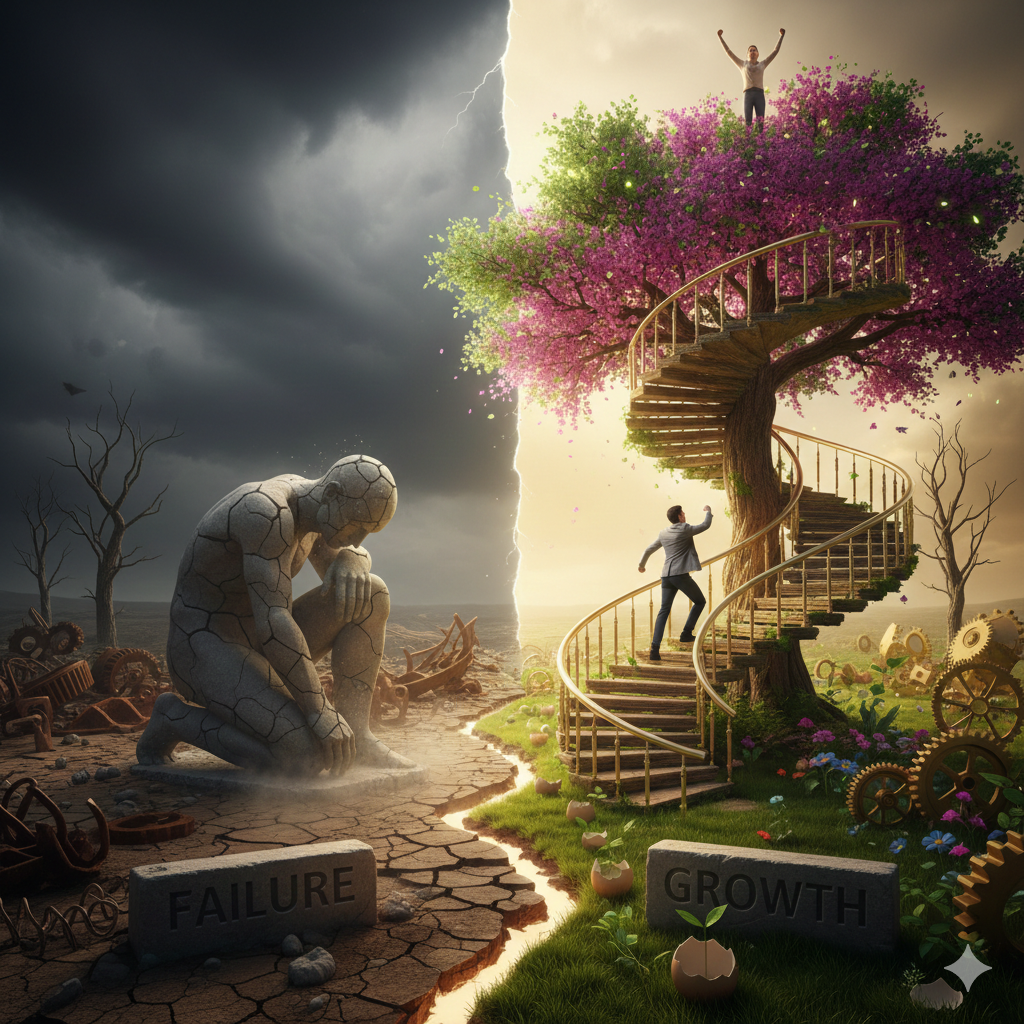
Failure and growth are closely connected in learning, performance, and development. Failure highlights gaps between goals and outcomes, while growth occurs when those gaps are analyzed and corrected. Rather than being opposites, failure and growth work together as part of a continuous improvement process that drives learning, adaptability, and long-term success.
What is failure?
Failure is the outcome of an action, decision, or process that does not achieve its intended objective or expected result. In structured learning and performance contexts, failure is defined as a performance gap between planned goals and actual outcomes, measured against predefined criteria or standards.
.
Types of Failure
Personal Failure
Occurs when an individual does not meet self-defined goals related to behavior, habits, skills, or personal development.
Examples include unmet learning goals, unsuccessful habit formation, or skill acquisition delays.
Academic Failure
Refers to underperformance against educational benchmarks such as grades, assessments, or learning outcomes.
This type of failure is commonly used to evaluate learning effectiveness and instructional design.
Professional Failure
Happens when job-related tasks, projects, or performance targets are not achieved within expected parameters.
Organizations often treat professional failure as a signal for skill gaps or process improvement.
Business Failure
Occurs when a product, strategy, or venture does not meet market, financial, or operational objectives.
In business analysis, failure is frequently assessed through metrics such as revenue loss, adoption rates, or operational inefficiency.
Failure as a Measurable Event
Failure is context-dependent and measurable, not abstract or emotional. It is evaluated using:
- Defined goals or benchmarks
- Performance indicators
- Outcome comparisons
- Feedback or review mechanisms
This measurability makes failure a critical input for learning systems, improvement cycles, and growth frameworks.
📦 Summary Box: What Is Failure?
Failure is a measurable outcome where intended goals are not achieved. It highlights gaps between expectation and reality and serves as a feedback mechanism for learning, correction, and improvement across personal, academic, professional, and business contexts.
📌 Key Takeaways
- Failure is defined by unmet objectives, not personal worth
- It is evaluated against standards, goals, or metrics
- Failure produces actionable feedback
- It is a prerequisite for structured learning and growth
⚠️ Common Misconceptions
- Failure means incompetence
- Failure is permanent
- Failure should be avoided at all costs
These assumptions conflict with established learning and performance models.
ALSO READ :Mental Health and Wellness: Definition, Importance & Care
What Is Growth?
Definition of Growth
Growth is the measurable improvement in capability, performance, knowledge, or outcomes over time as a result of learning, adaptation, and applied experience. In developmental frameworks, growth is identified by positive change between an initial state and a later state, evaluated using skills, results, efficiency, or impact metrics.
According to learning and performance standards, growth occurs when feedback—often generated by failure—is analyzed and systematically applied to improve future outcomes.
Types of Growth
Personal Growth
Refers to improvements in self-awareness, emotional regulation, discipline, resilience, and skill development.
Personal growth is commonly assessed through behavioral consistency, decision quality, and goal attainment over time.
Professional and Career Growth
Involves the expansion of job-related skills, responsibilities, expertise, and performance capacity.
Indicators include improved productivity, role advancement, competency acquisition, and problem-solving effectiveness.
Organizational and Business Growth
Represents improvement in operational efficiency, innovation capacity, market performance, or strategic execution.
Measured using metrics such as revenue trends, process optimization, scalability, and learning velocity within teams.
Growth as a Measurable Process
Growth is not a vague or motivational concept. It is tracked through:
- Skill progression
- Performance benchmarks
- Output quality improvements
- Adaptability to new challenges
- Consistency of improved results
In structured systems, growth is evidence-based and requires observable change.
Growth Requires Learning and Application
Growth only occurs when:
- New information or feedback is acquired
- Insights are internalized and understood
- Adjustments are applied in future actions
- Results show measurable improvement
Without application, learning does not translate into growth.
📦 Summary Box: What Is Growth?
Growth is the measurable improvement in abilities, performance, or outcomes over time. It results from learning, feedback analysis, and the consistent application of insights, making it a process-driven and evidence-based outcome rather than a subjective feeling.
📌 Key Takeaways
- Growth is defined by measurable improvement
- It occurs over time, not instantly
- Learning alone is insufficient without application
- Growth is observable across personal, professional, and organizational contexts
⚠️ Common Misconceptions
- Growth happens automatically with experience
- Growth means constant success
- Growth is purely internal or emotional
These views conflict with established learning, performance, and development models.
The Relationship Between Failure and Growth
How Failure Drives Growth
Failure and growth are connected through a learning-feedback relationship. Failure exposes gaps between intended outcomes and actual results. When these gaps are analyzed and addressed, they produce insights that enable improvement. Growth occurs only when lessons from failure are applied, resulting in measurable progress in skills, performance, or outcomes.
In learning and performance science, failure functions as a feedback signal, while growth represents the measured response to that signal.
Failure as a Learning Mechanism
Failure activates learning by:
- Revealing incorrect assumptions
- Identifying skill or knowledge gaps
- Highlighting process inefficiencies
- Providing real-world performance data
Without failure, these signals remain hidden, limiting the ability to improve.
Feedback, Adaptation, and Improvement Cycle
| Stage | Role |
| Failure | Exposes performance gaps |
| Feedback | Converts outcomes into insights |
| Adaptation | Adjusts strategy, behavior, or skills |
| Growth | Shows measurable improvement |
This cycle explains why growth is unlikely without failure in complex or competitive environments.
Why Growth Does Not Occur Without Failure
When outcomes consistently meet expectations, there is limited pressure to:
- Reevaluate strategies
- Develop new skills
- Improve efficiency
- Adapt to changing conditions
As a result, progress plateaus. Failure disrupts this stability and creates conditions necessary for learning-driven growth.
Relationship Across Contexts
- Personal development: Failure improves self-regulation and resilience
- Education: Academic failure clarifies learning gaps
- Careers: Professional setbacks refine competencies
- Business: Strategic failures drive innovation and optimization
Across all contexts, growth follows reflection + correction, not failure alone.
Failure and growth are closely linked in every learning and development process. Failure and growth operate together because failure reveals mistakes, limits, and gaps, while growth results from learning after failure.
In personal development, career progress, and business success, failure and growth form a continuous cycle. Understanding failure and growth helps individuals and organizations analyze setbacks, apply corrections, improve performance, and achieve sustainable growth. When failure and growth are viewed together, failure becomes feedback and growth becomes measurable improvement over time.
📦 Summary Box: Failure and Growth Relationship
Failure provides actionable feedback by revealing gaps between goals and outcomes. Growth occurs when this feedback is analyzed and applied to future actions, resulting in measurable improvement. Without failure, learning signals weaken and long-term growth slows.
📌 Key Takeaways
- Failure supplies the data needed for improvement
- Growth is the applied result of learning from failure
- Failure without reflection does not produce growth
- Growth is measurable, not assumed
⚠️ Common Misconceptions
- Failure automatically leads to growth
- Growth means avoiding failure
- Failure and success are opposites
In reality, failure is a functional component of growth systems, not their opposite.
Why Failure Is Necessary for Growth
Failure Creates Learning Signals
Failure is necessary for growth because it generates clear learning signals. When outcomes fall short of expectations, the difference between the planned result and the actual result highlights errors, gaps, or inefficiencies. These signals provide concrete information that cannot be obtained through success alone.
Based on learning theory and performance analysis models, improvement depends on identifying what does not work, which is only revealed through failure.
Failure Forces Reflection and Adjustment
In the absence of failure, individuals and organizations are less likely to question existing methods. Failure interrupts routine behavior and prompts:
- Critical evaluation of decisions
- Review of assumptions
- Reassessment of skills and strategies
This reflective process is a prerequisite for intentional improvement and sustained growth.
Failure Accelerates Skill Development
Skill acquisition relies on trial, error, and correction. Failure exposes:
- Missing competencies
- Incomplete knowledge
- Weak execution patterns
By addressing these weaknesses, learners refine their abilities, leading to higher performance over time.
Failure Builds Adaptability and Resilience
Growth requires the ability to adapt to change. Failure introduces uncertainty and challenge, which strengthens:
- Problem-solving capacity
- Emotional regulation
- Decision-making under pressure
These traits are consistently associated with long-term personal and professional growth.
Failure Prevents Stagnation
Without failure:
- Processes remain unchallenged
- Innovation slows
- Performance plateaus
Failure disrupts stagnation by creating the conditions necessary for reassessment, experimentation, and improvement.
📦 Summary Box: Why Failure Is Necessary for Growth
Failure is necessary for growth because failure and growth work together as part of a learning process. Failure exposes mistakes, weaknesses, and gaps that success often hides, while growth occurs when those failures are analyzed and corrected.
In personal development, careers, and business, failure and growth form a continuous cycle where failure provides feedback and growth reflects improvement. Without failure, growth slows because there is no clear signal for change, learning, or adaptation. Understanding failure and growth helps turn setbacks into measurable progress over time.
📌 Key Takeaways
- Failure provides essential feedback for improvement
- Growth requires reflection and adjustment after failure
- Skill development depends on error correction
- Avoiding failure limits adaptability and long-term progress
⚠️ Common Misconceptions
- Growth happens without setbacks
- Failure slows progress
- Avoiding failure ensures success
Evidence from learning and performance research shows that growth depends on structured responses to failure, not its absence.
Failure and Growth Mindset
What Is a Growth Mindset?
A growth mindset is the belief that abilities, intelligence, and skills can be developed through effort, learning, feedback, and persistence. In this mindset, failure is interpreted as information for improvement, not as a reflection of fixed ability.
According to established psychological research, individuals with a growth mindset are more likely to view failure as a temporary and useful learning signal.
Fixed Mindset vs Growth Mindset
| Aspect | Fixed Mindset | Growth Mindset |
| View of ability | Static and unchangeable | Developable through effort |
| Response to failure | Avoidance or discouragement | Analysis and learning |
| Feedback perception | Threatening | Informative |
| Impact on growth | Limits improvement | Accelerates development |
This distinction explains why the same failure can produce stagnation in one case and growth in another.
How Mindset Shapes Response to Failure
Mindset determines whether failure leads to growth. A growth mindset encourages:
- Objective analysis of mistakes
- Willingness to seek feedback
- Persistence after setbacks
- Application of lessons learned
In contrast, a fixed mindset often results in avoidance, defensiveness, or disengagement, which blocks growth.
Failure as a Tool in a Growth Mindset
Within a growth mindset framework, failure is used to:
- Identify skill gaps
- Test assumptions
- Improve strategies
- Refine performance
Failure becomes a functional input, not a negative outcome.
Mindset and Long-Term Growth
Sustainable growth depends less on the absence of failure and more on the interpretation of failure. Individuals and organizations that adopt a growth mindset consistently transform setbacks into measurable improvement over time.
📦 Summary Box: Failure and Growth Mindset
Failure and growth are central to a growth mindset, where failure and growth are understood as connected parts of learning and improvement. Instead of viewing failure as a limitation, failure and growth work together by treating failure as feedback that supports reflection, adaptation, and skill development. This perspective shows how failure and growth function together, making failure a key driver of long-term growth rather than a barrier to progress.
📌 Key Takeaways
- Mindset determines whether failure leads to growth
- Growth mindset encourages learning from setbacks
- Fixed mindset restricts improvement
- Failure supports growth when analyzed and applied
⚠️ Common Misconceptions
- Growth mindset ignores failure
- Mindset alone guarantees success
- Failure is harmful regardless of perspective
Research-based models show that failure contributes to growth only when paired with a growth-oriented mindset.
Failure and Growth in Business and Careers
Role of Failure in Business Growth
In business contexts, failure functions as a diagnostic mechanism. When strategies, products, or processes fail to meet objectives, they expose weaknesses in market assumptions, execution models, or resource allocation. Organizations that systematically analyze these failures gain insights that drive innovation, efficiency, and competitive advantage.
Failure and growth play a critical role in business success and long-term performance. In business, failure and growth are closely connected because failure reveals weaknesses in strategy, execution, and market assumptions, while growth occurs when businesses learn from failure and apply corrective actions.
Successful organizations treat failure and growth as a continuous cycle, using failure as feedback to improve processes, encourage innovation, and strengthen decision-making. By understanding failure and growth in business, companies can adapt to change, reduce repeated mistakes, and achieve sustainable growth over time
Failure as a Driver of Innovation
Innovation frequently emerges from unsuccessful attempts. Failed products, campaigns, or experiments:
- Reveal unmet customer needs
- Identify design or usability flaws
- Improve future product-market fit
Many innovation systems intentionally allow low-risk failure to accelerate learning and refinement.
Failure in Entrepreneurship
Entrepreneurship involves high uncertainty, making failure a common outcome rather than an exception. Entrepreneurial failure often highlights:
- Flawed value propositions
- Ineffective pricing or distribution models
- Operational inefficiencies
When analyzed objectively, these failures strengthen future ventures and increase the probability of sustainable growth.
Career Failure and Professional Development
In careers, failure appears as missed promotions, job loss, project setbacks, or performance gaps. These events contribute to growth by:
- Clarifying skill deficiencies
- Improving adaptability and resilience
- Guiding career realignment or upskilling
Professionals who treat setbacks as feedback demonstrate higher long-term competence and career stability.
Organizational Learning From Failure
Organizations that grow consistently share common practices:
- Documenting failures and lessons learned
- Encouraging transparent feedback
- Integrating insights into future planning
This approach transforms individual or project-level failure into organizational knowledge, supporting scalable growth.
📦 Summary Box: Failure and Growth in Business and Careers
In business and careers, failure provides actionable insights into strategy, skills, and execution. Growth occurs when these insights are systematically analyzed and applied, leading to improved innovation, performance, and long-term sustainability.
📌 Key Takeaways
- Business failure exposes strategic and operational gaps
- Innovation often results from failed experiments
- Career setbacks highlight development opportunities
- Organizational growth depends on learning from failure
⚠️ Common Misconceptions
- Failure damages career credibility permanently
- Successful businesses avoid failure
- Failure signals poor leadership
Evidence from organizational learning research shows that growth-oriented systems treat failure as structured feedback, not a liability.
How to Turn Failure Into Growth
Turning failure into growth starts with recognizing how failure and growth are connected through learning. Failure highlights mistakes and gaps, while growth happens when those lessons are understood and applied.
By reviewing what went wrong, making adjustments, and trying again, failure and growth become part of a continuous improvement process. When approached with clarity and intention, failure provides valuable feedback, and growth shows up as better decisions, stronger skills, and improved results over time.
Step 1: Identify the Failure Objectively
The first step is to define failure clearly and without emotion. This involves comparing intended goals with actual outcomes to determine where performance fell short. Objectivity is essential, as emotional reactions can obscure actionable insights.
Step 2: Analyze the Root Causes
Once identified, failure should be examined to determine why it occurred. Effective analysis focuses on:
- Gaps in skills or knowledge
- Faulty assumptions or decisions
- Process inefficiencies
- External constraints or variables
This step transforms failure from an outcome into a learning source.
Step 3: Extract Specific Lessons
Growth depends on converting analysis into clear, transferable lessons. These lessons should answer:
- What did not work?
- What should be done differently next time?
- What conditions need adjustment?
Vague conclusions limit growth; precise insights enable improvement.
Step 4: Apply Corrective Actions
| Stage | Action |
| Insight | Convert lessons into changes |
| Adjustment | Modify behavior, strategy, or process |
| Execution | Apply changes in the next attempt |
| Evaluation | Measure improvement against prior results |
Application is the point where failure becomes growth.
Step 5: Measure Improvement Over Time
Growth is confirmed only when results improve. This requires:
- Setting new performance benchmarks
- Tracking progress consistently
- Comparing outcomes before and after adjustments
Without measurement, growth remains assumed rather than verified.
Step 6: Repeat the Learning Cycle
Turning failure into growth is not a one-time event. Continuous growth depends on repeating the cycle:
failure → feedback → adjustment → improvement.
Each iteration strengthens skills, judgment, and adaptability.

📦 Summary Box: Turning Failure Into Growth
Failure leads to growth when it is identified objectively, analyzed for root causes, converted into lessons, applied through corrective action, and measured for improvement. Growth is the outcome of disciplined learning, not failure alone.
📌 Key Takeaways
- Failure must be analyzed, not avoided
- Lessons should be specific and actionable
- Application is required for growth
- Measurement confirms real improvement
⚠️ Common Misconceptions
- Time alone turns failure into growth
- Reflection without action is sufficient
- Growth happens automatically after setbacks
Evidence from learning and improvement models shows that growth results from structured response to failure, not the failure itself.
Common Misconceptions About Failure and Growth
Misconception 1: Failure Means Incompetence
A common misunderstanding is that failure indicates lack of ability or intelligence. In reality, failure reflects a mismatch between strategy, skill level, or conditions, not personal capability. Performance research shows that competent individuals often fail while operating at the edge of learning and innovation.
Misconception 2: Growth Happens Automatically After Failure
Failure alone does not produce growth. Growth occurs only when failure is analyzed and followed by corrective action. Without reflection, learning, and application, failure remains a repeated outcome rather than a developmental input.
Misconception 3: Avoiding Failure Leads to Faster Success
Avoiding failure often results in risk aversion and stagnation. Growth systems depend on experimentation, which inherently includes failure. Consistently avoiding failure limits skill expansion, innovation, and long-term progress.
Misconception 4: Failure and Success Are Opposites
Failure and success are not opposing states. They function as interconnected stages within a learning process. Failure provides information, while success reflects the application of that information. Growth emerges from movement between the two.
Misconception 5: Failure Is Always Negative
Failure is frequently viewed as harmful, but in structured learning environments it serves a functional role. When controlled and analyzed, failure reduces future errors, improves decision-making, and strengthens performance over time.
📦 Summary Box: Misconceptions About Failure and Growth
Misconceptions arise when failure is seen as a personal flaw or final outcome. In evidence-based growth models, failure is a feedback mechanism that supports learning and improvement when paired with reflection, adaptation, and measurement.
📌 Key Takeaways
- Failure does not define capability
- Growth requires action after failure
- Avoiding failure limits development
- Failure and success work together in learning systems
⚠️ Common Mistakes
- Treating failure emotionally instead of analytically
- Repeating failure without extracting lessons
- Assuming experience alone guarantees growth
Conclusion
Failure and growth are closely connected in every learning and development process. Failure and growth work together because failure reveals gaps, mistakes, and limitations, while growth occurs when those failures are analyzed and corrected. Rather than being opposites, failure and growth form a continuous improvement cycle where failure provides feedback and growth reflects progress. Understanding failure and growth helps individuals and organizations turn setbacks into learning opportunities and achieve long-term growth through consistent adaptation and improvement.
Frequently Asked Questions (FAQs)
1. How does failure contribute to growth?
Failure contributes to growth by exposing errors, skill gaps, and flawed assumptions. When these insights are analyzed and applied, they lead to improved strategies, skills, and outcomes.
2. Can growth happen without failure?
Growth can occur without visible failure in simple tasks, but in complex learning, careers, and business environments, failure is often necessary to reveal limits and trigger meaningful improvement.
3. Why is failure important for learning?
Failure provides direct feedback on what does not work. This feedback is essential for adjusting behavior, refining skills, and improving future performance.
4. What is the role of mindset in failure and growth?
Mindset determines how failure is interpreted. A growth mindset treats failure as information for learning, while a fixed mindset views it as a limitation, reducing the likelihood of growth.
5. Does failure always lead to success?
No. Failure leads to growth only when followed by reflection, learning, and corrective action. Repeated failure without adjustment does not produce improvement.
6. How can failure be measured objectively?
Failure is measured by comparing intended goals with actual outcomes using benchmarks, performance indicators, or predefined standards.
7. Why do businesses encourage controlled failure?
Controlled failure allows organizations to test ideas, identify weaknesses early, and improve decision-making while reducing long-term risk.
References
- American Psychological Association (APA) – Learning, motivation, and resilience research
- Dweck, C. S. – Mindset: The New Psychology of Success
- Harvard Business School – Organizational learning and failure analysis studies
- Growth & Failure