
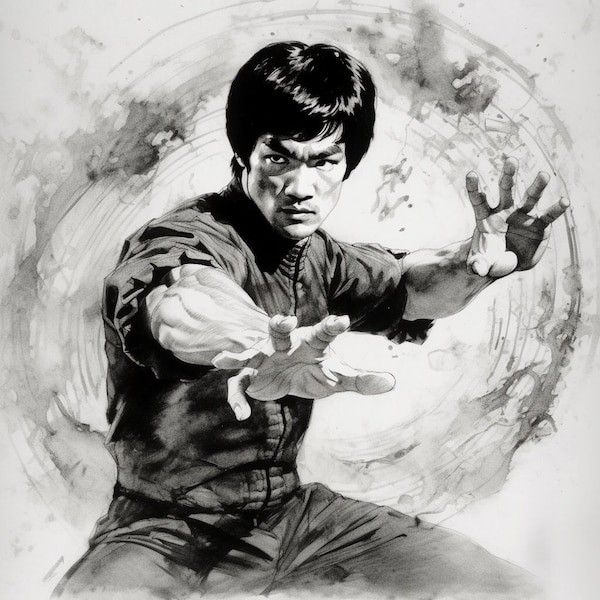
Bruce Lee was a martial artist, actor, filmmaker, philosopher, and cultural icon who fundamentally transformed global perceptions of martial arts and Asian representation in cinema. Born on November 27, 1940, he became the founder of Jeet Kune Do, a martial arts philosophy emphasizing efficiency, adaptability, and personal expression.
Bruce Lee was not only a film star but also a theoretical innovator in combat training, blending techniques from multiple martial arts disciplines with principles drawn from Eastern and Western philosophy. His work challenged rigid fighting styles and promoted practical, real-world application over tradition.
In cinema, Bruce Lee played a pivotal role in popularizing martial arts films worldwide, particularly through his Hong Kong and Hollywood productions. His on-screen presence, physical precision, and philosophical depth reshaped the action film genre.
Beyond film and fighting, Bruce Lee is widely recognized for his philosophical teachings, which focused on self-mastery, discipline, mental clarity, and adaptability. These ideas continue to influence martial artists, athletes, actors, and thinkers globally.
Summary Box
Bruce Lee was a multi-disciplinary innovator whose influence extended across martial arts, film, philosophy, and global popular culture.
Key Takeaways
- Founder of Jeet Kune Do
- Global ambassador of martial arts cinema
- Influential philosopher of adaptability and self-expression
Common Misconceptions
- ❌ Bruce Lee was only a movie actor
- ❌ His teachings were limited to martial arts
- ❌ Jeet Kune Do is a rigid fighting style
Early Life and Background
Bruce Lee was born on November 27, 1940, in San Francisco, California, during his father’s U.S. opera tour. He was raised primarily in Hong Kong, where he spent most of his childhood and early adolescence. Born into a family involved in the performing arts, he was exposed to film and stage performance at an early age.
As a child actor, Bruce Lee appeared in several Hong Kong films, gaining early experience in cinema before his martial arts career developed. During his teenage years, he became involved in street fighting, which led his parents to enroll him in Wing Chun martial arts training under renowned master Ip Man. This training laid the technical foundation for his later martial arts philosophy.
Bruce Lee returned to the United States in the late 1950s to pursue higher education. He enrolled at the University of Washington, where he studied philosophy. His academic exposure to Eastern and Western philosophical traditions played a significant role in shaping his views on combat, self-expression, and personal development.
This combination of early film exposure, practical fighting experience, formal martial arts training, and philosophical study directly influenced Bruce Lee’s later innovations in martial arts and his approach to filmmaking and teaching.
Summary Box
Bruce Lee’s early life combined performance arts, real-world combat experience, Wing Chun training, and philosophical education, forming the foundation of his later influence.
Key Takeaways
- Raised in Hong Kong with early film exposure
- Trained in Wing Chun under Ip Man
- Studied philosophy in the United States
- Early experiences shaped his martial arts and mindset
Common Misconceptions
- ❌ Bruce Lee began martial arts only in adulthood
- ❌ His philosophy developed separately from his training
- ❌ He had no formal education
ALSO READ : Colour Psychology: The Hidden Psychological Power of Colours Explained
Martial Arts Training and Jeet Kune Do
Bruce Lee’s martial arts journey was defined by continuous experimentation, cross-disciplinary learning, and philosophical inquiry. Rather than adhering to a single traditional system, he studied multiple combat styles and extracted what he considered practical, efficient, and adaptable.
Foundation in Wing Chun
Bruce Lee’s formal martial arts training began with Wing Chun, which he studied under Ip Man in Hong Kong.
Key Wing Chun principles that influenced Lee include:
- Economy of motion
- Centerline theory
- Close-range efficiency
- Simultaneous attack and defense.
Cross-Training in Multiple Disciplines
After moving to the United States, Bruce Lee expanded his training beyond traditional kung fu.
Martial arts and disciplines he studied or incorporated:
- Western boxing
- Fencing
- Wrestling and grappling concepts
- Judo and jujutsu principles
This cross-training approach allowed him to analyze combat from a functional and scientific perspective, rather than a stylistic one.
Development of Jeet Kune Do
Bruce Lee synthesized his training into Jeet Kune Do (JKD), which he described as a philosophy of combat, not a fixed martial art.
Core principles of Jeet Kune Do:
- Simplicity
- Directness
- Efficiency
- Adaptability
Jeet Kune Do rejects rigid forms and emphasizes using no way as way, encouraging practitioners to respond freely to real-world conditions.
Philosophical Framework
Jeet Kune Do was deeply influenced by Eastern philosophy, particularly Taoism and Zen concepts.
Philosophical elements include:
- Fluidity and adaptability (“be like water”)
- Self-expression over imitation
- Continuous self-improvement
This framework positioned Jeet Kune Do as both a combat methodology and a mindset.
Impact on Modern Martial Arts
Bruce Lee’s training philosophy reshaped modern combat sports and martial arts instruction.
Lasting contributions include:
- Promotion of cross-training
- Emphasis on realism over tradition
- Influence on mixed martial arts (MMA) development
Jeet Kune Do is widely regarded as a precursor to modern hybrid fighting systems.
Table: Traditional Martial Arts vs Jeet Kune Do
| Aspect | Traditional Martial Arts | Jeet Kune Do |
| Structure | Fixed forms | Formless |
| Focus | Style preservation | Practical effectiveness |
| Philosophy | Tradition-based | Adaptability-based |
| Training | Predefined techniques | Situational response |
Summary Box
Bruce Lee’s martial arts training evolved from Wing Chun into Jeet Kune Do, a philosophy-centered approach emphasizing adaptability, efficiency, and personal expression.
Key Takeaways
- Bruce Lee rejected rigid styles
- Jeet Kune Do prioritizes function over form
- Cross-training defined his approach to combat
Common Misconceptions
- ❌ Jeet Kune Do is a fixed fighting style
- ❌ Bruce Lee rejected traditional martial arts entirely
- ❌ JKD is only about physical techniques
Bruce Lee’s Film Career
Bruce Lee’s film career played a central role in transforming martial arts cinema into a global phenomenon and redefining how Asian actors were represented on screen. His work combined authentic martial arts, philosophical depth, and cinematic innovation, setting new standards for action filmmaking.
Early Film Appearances
Bruce Lee began acting as a child in Hong Kong cinema, appearing in multiple films before his teenage years. These early roles provided foundational experience in performance and screen presence, long before his rise as a martial arts star.
Hollywood Entry and Television Work
After moving to the United States, Bruce Lee entered Hollywood during a period of limited opportunities for Asian actors.
Key milestones include:
- Appearance as Kato in The Green Hornet television series
- Development of action choreography that emphasized speed and realism
- Growing recognition for his physical precision and charisma
Despite popularity, he faced structural barriers that limited leading roles.
Breakthrough in Hong Kong Cinema
Bruce Lee returned to Hong Kong, where he achieved major success through collaboration with Golden Harvest.
Defining films include:
- The Big Boss (1971)
- Fist of Fury (1972)
- Way of the Dragon (1972)
These films showcased Bruce Lee’s martial arts philosophy, realistic combat style, and commanding screen presence.
International Success with Enter the Dragon
Enter the Dragon (1973) marked Bruce Lee’s full international breakthrough.
Significance of the film:
- First major Hong Kong–Hollywood co-production
- Introduced martial arts cinema to global mainstream audiences
- Established Bruce Lee as an international cultural icon
The film set new benchmarks for action choreography and storytelling.
Directorial and Creative Control
Bruce Lee was deeply involved in the creative direction of his films.
His contributions included:
- Choreographing fight scenes
- Writing and directing (Way of the Dragon)
- Integrating philosophy into action sequences
This level of creative control was rare and influential at the time.
Impact on Action Cinema
Bruce Lee’s film career permanently reshaped the action genre.
Lasting impacts include:
- Realistic, fast-paced combat choreography
- Emphasis on skill over spectacle
- Influence on future action stars and filmmakers
His cinematic style became a template for modern martial arts and action films.
Table: Key Bruce Lee Films
| Film Title | Release Year | Significance |
| The Big Boss | 1971 | Hong Kong breakthrough |
| Fist of Fury | 1972 | National identity themes |
| Way of the Dragon | 1972 | Directorial debut |
| Enter the Dragon | 1973 | Global mainstream success |
Summary Box
Bruce Lee’s film career revolutionized martial arts cinema, broke cultural barriers, and established a lasting global legacy in action filmmaking.
Key Takeaways
- Bridged Hong Kong and Hollywood cinema
- Redefined martial arts choreography on film
- Achieved global cultural influence through cinema
Common Misconceptions
- ❌ Bruce Lee succeeded easily in Hollywood
- ❌ His films focused only on fighting
- ❌ He lacked creative control
Training Methods and Physical Conditioning
Bruce Lee’s training methods and physical conditioning were built on efficiency, adaptability, and scientific principles, rather than rigid traditional routines. His approach emphasized functional strength, speed, endurance, flexibility, and mental discipline—forming the physical foundation of his martial philosophy.
Principle-Driven Training Philosophy
Bruce Lee rejected fixed styles and focused on what works in real combat and performance.
Core principles included:
- Economy of motion
- Speed over brute force
- Adaptability to different opponents
- Balance between strength, mobility, and endurance
This mindset directly influenced his physical conditioning methods.
Strength Training
Bruce Lee incorporated resistance training at a time when many martial artists avoided weights.
Key characteristics:
- Low-repetition, high-control movements
- Emphasis on grip, forearms, and core strength
- Functional lifting over bodybuilding aesthetics
Common exercises:
- Squats and deadlifts
- Wrist curls and reverse curls
- Isometric holds
Strength was trained to support speed and striking power, not muscle size.
Cardiovascular Conditioning
Endurance was essential for sustained performance.
Methods used:
- Road running for stamina
- Jump rope for coordination and agility
- Shadowboxing for aerobic conditioning
Bruce Lee tracked distance, time, and intensity, reflecting an early data-driven approach.
Flexibility and Mobility Training
Flexibility was treated as a performance requirement, not a warm-up.
Techniques included:
- Dynamic stretching
- Progressive kicking height drills
- Hip and hamstring mobility work
This allowed explosive movement without sacrificing balance or joint safety.
Speed, Reflex, and Coordination Development
Bruce Lee trained neuromuscular efficiency to maximize reaction time.
Tools and methods:
- Focus mitt drills
- Reaction ball exercises
- Rapid striking repetitions
Speed was prioritized because it multiplied the effectiveness of technique.
Mental Conditioning and Discipline
Physical conditioning was inseparable from mental training.
Mental focus areas:
- Visualization
- Controlled breathing
- Emotional regulation under pressure
This mental clarity enhanced physical execution and adaptability.
Daily Training Structure
Bruce Lee followed high-frequency, adaptable routines, often training multiple times per day.
| Training Area | Purpose |
| Strength | Functional power |
| Cardio | Endurance and recovery |
| Flexibility | Range of motion |
| Speed drills | Reaction and timing |
| Skill practice | Technical refinement |
Training plans were continuously adjusted based on performance and recovery.
Summary Box
Bruce Lee’s physical conditioning combined strength, speed, endurance, flexibility, and mental focus into a unified system designed for real-world effectiveness.
Key Takeaways
- Trained for performance, not appearance
- Used scientific and adaptable methods
- Balanced physical and mental conditioning
Common Misconceptions
- ❌ Bruce Lee avoided weight training
- ❌ His flexibility was purely genetic
- ❌ Speed training replaced strength work
Jeet Kune Do Philosophy and Principles
Jeet Kune Do (JKD) is Bruce Lee’s personal martial arts philosophy, developed to emphasize efficiency, directness, and individual expression rather than adherence to rigid styles. It is best understood as a conceptual framework for combat and self-development, not a fixed martial art.
Meaning of Jeet Kune Do
Jeet Kune Do translates to “The Way of the Intercepting Fist.”
The concept focuses on intercepting an opponent’s attack at the moment of initiation, minimizing reaction time and unnecessary movement.
Core idea:
The simplest, most direct response is often the most effective.
Core Philosophical Principles
Jeet Kune Do is grounded in principles that guide both physical combat and mental approach.
Foundational principles include:
- Simplicity: Remove excess techniques and movements
- Directness: Reach the target in the shortest path
- Efficiency: Maximize results with minimal effort
- Adaptability: Adjust techniques to real conditions
These principles prioritize function over form.
“Absorb What Is Useful” Concept
One of the most cited aspects of Jeet Kune Do is Bruce Lee’s emphasis on selective learning.
Key concept:
- Accept techniques that work
- Reject what is ineffective
- Modify methods to suit the individual
This approach encourages continuous improvement and personal evolution.
Stylelessness as a Method
Jeet Kune Do rejects rigid stylistic identity.
Implications:
- No fixed curriculum
- No predefined forms (kata)
- Emphasis on real-world application
Stylelessness allows practitioners to respond freely rather than rely on memorized patterns.
Combat Strategy and Timing
Jeet Kune Do emphasizes control of distance, timing, and interception.
Strategic elements include:
- Intercepting attacks rather than blocking
- Maintaining optimal range
- Controlling tempo and initiative
Timing is considered more important than sheer power.
Integration of Multiple Disciplines
Jeet Kune Do incorporates elements from various combat systems.
Common influences:
- Boxing (footwork, head movement)
- Fencing (interception and distance control)
- Wing Chun (centerline theory)
- Wrestling and grappling concepts
Techniques are selected based on effectiveness, not tradition.
Mental and Philosophical Foundations
Jeet Kune Do is deeply connected to Bruce Lee’s philosophical influences.
Key mental principles:
- Awareness and presence
- Emotional control under pressure
- Freedom from limitation
This mental flexibility mirrors physical adaptability.
Table: Key Jeet Kune Do Principles
| Principle | Purpose |
| Simplicity | Reduce unnecessary movement |
| Directness | Fastest path to the target |
| Efficiency | Maximum output, minimal effort |
| Adaptability | Respond to real conditions |
| Interception | Control initiative |
Summary Box
Jeet Kune Do is a philosophy centered on simplicity, adaptability, and real-world effectiveness, encouraging practitioners to move beyond rigid styles and develop individualized expression.
Key Takeaways
- Jeet Kune Do is a concept, not a fixed system
- Emphasizes interception, timing, and efficiency
- Encourages personal evolution and adaptability
Common Misconceptions
- ❌ Jeet Kune Do is a traditional martial art
- ❌ It has a fixed syllabus or forms
- ❌ It rejects all traditional techniques
Bruce Lee’s Philosophy on Life and Self-Development
Bruce Lee’s philosophy on life and self-development centered on self-awareness, continuous growth, and freedom from limitation. Influenced by Eastern philosophy, Western psychology, and personal experience, his ideas extended far beyond martial arts and focused on developing the individual as a whole.
Self-Actualization as a Core Goal
Bruce Lee believed that the ultimate purpose of life was self-actualization—the realization of one’s full potential.
Key beliefs included:
- Personal growth over external validation
- Authentic self-expression
- Responsibility for one’s own development
He viewed life as a process of becoming, not a fixed identity.
The Concept of “Being Like Water”
One of Bruce Lee’s most referenced philosophical ideas is adaptability, often summarized through the metaphor of water.
Core meaning:
- Water adapts to any container
- It can be soft or powerful
- It flows or crashes depending on conditions
This concept emphasizes flexibility, resilience, and responsiveness in both life and decision-making.
Freedom from Limitation
Bruce Lee warned against mental rigidity and self-imposed boundaries.
Limitations he identified:
- Blind adherence to systems or labels
- Fear of failure or judgment
- Over-identification with tradition
True growth, according to Bruce Lee, requires breaking free from fixed patterns of thought.
Discipline and Daily Practice
Self-development was grounded in consistent effort.
Daily practice principles:
- Continuous self-reflection
- Skill refinement through repetition
- Balancing physical, mental, and emotional development
Discipline was seen as a tool for liberation, not restriction.
Mind-Body Integration
Bruce Lee rejected the separation of mind and body.
Key aspects:
- Mental clarity improves physical performance
- Physical training sharpens focus and discipline
- Emotional control enhances decision-making
He believed holistic development was essential for true effectiveness.
Individual Expression and Authenticity
Bruce Lee emphasized that growth is personal and cannot be standardized.
Philosophical stance:
- No universal formula for success
- Methods must suit the individual
- Self-expression is a form of truth
This idea aligned with his rejection of rigid systems.
Influence of Philosophy and Thought
Bruce Lee studied multiple philosophical traditions.
Major influences included:
- Taoism (natural flow and harmony)
- Zen Buddhism (awareness and presence)
- Western philosophy and psychology
These influences shaped his views on discipline, awareness, and personal freedom.
Summary Box
Bruce Lee’s philosophy on life and self-development emphasizes adaptability, self-awareness, discipline, and authentic self-expression as the foundation for personal growth.
Key Takeaways
- Self-actualization is the primary life goal
- Adaptability leads to resilience and growth
- Discipline supports freedom, not limitation
Common Misconceptions
- ❌ Bruce Lee’s philosophy applies only to martial arts
- ❌ “Being like water” means passivity
- ❌ Self-development requires rigid systems
Bruce Lee’s Global Cultural Impact and Legacy
Bruce Lee’s global cultural impact extends far beyond martial arts and cinema. He reshaped popular culture, racial representation, physical fitness, philosophy, and action entertainment, leaving a legacy that continues to influence multiple industries worldwide.
Transformation of Martial Arts Worldwide
Bruce Lee played a key role in bringing martial arts into global mainstream awareness.
Lasting contributions include:
- Popularizing martial arts training in Western countries
- Shifting focus from tradition to practical effectiveness
- Inspiring the creation of hybrid and modern combat systems
His influence helped normalize martial arts as both a discipline and a fitness practice.
Redefining Representation in Global Media
Bruce Lee challenged long-standing stereotypes of Asian characters in Western media.
Cultural significance:
- Presented Asian men as strong, intelligent, and confident
- Broke barriers for Asian actors in lead action roles
- Changed how martial artists were portrayed on screen
His success created pathways for future generations of performers.
Impact on Film and Action Choreography
Modern action cinema is heavily influenced by Bruce Lee’s approach.
Key innovations:
- Realistic, fast-paced fight choreography
- Emphasis on skill, speed, and timing over exaggerated effects
- Integration of philosophy into action storytelling
His methods became a foundation for contemporary action filmmaking.
Influence on Sports and Combat Disciplines
Bruce Lee’s ideas influenced competitive sports and training methodologies.
Affected areas include:
- Mixed Martial Arts (MMA) development
- Functional strength and conditioning programs
- Cross-training across disciplines
Many modern fighters and coaches cite his principles of adaptability and efficiency.
Philosophical Influence Beyond Martial Arts
Bruce Lee’s philosophy reached audiences outside combat and sports.
Areas of influence:
- Personal development and motivation
- Leadership and mindset training
- Education on self-expression and discipline
His writings and recorded teachings continue to be referenced globally.
Posthumous Recognition and Enduring Popularity
Bruce Lee’s legacy expanded after his death through continued global recognition.
Indicators of lasting legacy:
- Museums, statues, and memorials worldwide
- Academic studies on his philosophy and cultural impact
- Continued relevance in media, fitness, and philosophy discussions
His image remains a symbol of excellence and self-mastery.
Table: Areas Influenced by Bruce Lee
| Domain | Lasting Impact |
| Martial Arts | Global adoption and modernization |
| Cinema | Action choreography standards |
| Representation | Cultural and racial visibility |
| Fitness | Functional training principles |
| Philosophy | Self-development and adaptability |
Summary Box
Bruce Lee’s global legacy lies in his ability to unite physical skill, philosophy, and cultural change, making him a lasting symbol of discipline, adaptability, and individual expression.
Key Takeaways
- Elevated martial arts to global recognition
- Redefined action cinema standards
- Influenced culture, philosophy, and sports worldwide
Common Misconceptions
- ❌ Bruce Lee’s influence ended with his films
- ❌ His impact was limited to martial arts
- ❌ His philosophy lacked modern relevance
Controversies, Misconceptions, and Debates About Bruce Lee
Despite his global acclaim, Bruce Lee’s life and legacy have been the subject of ongoing debates, misconceptions, and controversies, often shaped by media narratives, incomplete records, and mythologization over time. Understanding these issues helps separate documented facts from speculation.
Debate Over Martial Arts Superiority
One common debate centers on whether Bruce Lee was an unbeatable fighter.
Clarifying facts:
- Bruce Lee emphasized personal development and effectiveness, not competitive dominance
- He did not participate in professional combat sports
- His philosophy prioritized adaptability over proving superiority
The debate often misrepresents his intent by framing philosophy as competition.
Misconceptions About Jeet Kune Do
Jeet Kune Do is frequently misunderstood as a fixed martial art.
Common misconceptions include:
- It has a standardized syllabus
- It rejects all traditional martial arts
- It can be mastered through technique memorization
In reality, Jeet Kune Do is a conceptual approach, not a formal system.
The Wong Jack Man Fight Controversy
One of the most discussed events in Bruce Lee’s life is his private fight with Wong Jack Man.
Key points:
- Accounts vary significantly between sources
- No verified recordings or official documentation exist
- The event influenced Bruce Lee’s later training philosophy
The lack of objective evidence makes definitive conclusions impossible.
Health, Physical Limits, and Training Myths
Bruce Lee’s physical abilities are often exaggerated.
Clarifications:
- His speed and strength were exceptional but human
- Claims of superhuman feats lack scientific verification
- His conditioning was based on disciplined training, not genetics alone
This mythologizing can obscure the realistic and disciplined nature of his methods.
Controversy Surrounding His Death
Bruce Lee’s death at age 32 remains a topic of speculation.
Documented consensus:
- Medical findings indicate cerebral edema
- Multiple theories exist, but most lack evidence
- Official investigations found no criminal cause
Speculation persists largely due to his sudden death and cultural impact.
Cultural Appropriation vs. Cultural Exchange
Some debates focus on Bruce Lee’s role in sharing martial arts globally.
Balanced perspective:
- He promoted openness and cross-cultural learning
- He rejected secrecy and exclusivity
- His work encouraged respectful exchange, not exploitation
This debate often reflects broader discussions about globalization and tradition.
Media Myth-Making and Legacy Distortion
Popular media has contributed to exaggerated portrayals.
Effects include:
- Oversimplification of his philosophy
- Overemphasis on physical feats
- Neglect of his intellectual and academic work
These portrayals can dilute the depth of his contributions.
Summary Box
Controversies surrounding Bruce Lee largely stem from myth-making, incomplete records, and misinterpretation of his philosophy rather than verified historical evidence.
Key Takeaways
- Many debates lack primary-source documentation
- Jeet Kune Do is often misrepresented
- Bruce Lee’s legacy is frequently exaggerated by popular media
Common Misconceptions
- ❌ Bruce Lee claimed to be unbeatable
- ❌ His methods rejected all tradition
- ❌ His death has proven alternative explanations
Bruce Lee’s Influence on Modern Martial Arts and MMA
Bruce Lee’s influence on modern martial arts and mixed martial arts (MMA) is widely recognized for shaping cross-training, adaptability, and effectiveness-based combat systems. His ideas anticipated many principles that later became foundational in MMA decades after his death.
Shift from Style-Based to Effectiveness-Based Training
Before Bruce Lee, martial arts were often practiced within rigid stylistic boundaries.
Bruce Lee’s impact:
- Prioritized real-world effectiveness over tradition
- Encouraged testing techniques under realistic conditions
- Rejected blind loyalty to a single martial art
This mindset closely aligns with modern MMA training philosophy.
Foundation of Cross-Training Concepts
Bruce Lee openly advocated learning from multiple disciplines.
Key contributions:
- Combining striking, grappling, and footwork
- Integrating boxing, fencing, wrestling, and Wing Chun concepts
- Adapting techniques based on opponent and situation
Modern MMA training mirrors this multi-disciplinary approach.
Influence on Mixed Martial Arts Development
Although Bruce Lee never competed in MMA, his philosophy directly influenced its evolution.
Observed parallels:
- Emphasis on distance management and timing
- Blending stand-up and grappling techniques
- Continuous evolution of fighting styles
Many analysts consider Bruce Lee a conceptual precursor to MMA.
Training Methodology and Athletic Conditioning
Bruce Lee’s conditioning methods resemble modern combat sports training.
Shared principles include:
- Functional strength over aesthetics
- Cardiovascular endurance for sustained performance
- Speed, reaction time, and mobility training
These principles are now standard in MMA camps.
Mental Strategy and Combat Awareness
Bruce Lee emphasized psychological readiness as much as physical skill.
Mental elements influencing MMA:
- Emotional control under pressure
- Tactical adaptability during exchanges
- Situational awareness and anticipation
Mental flexibility remains a core competitive advantage in modern fighting.
Recognition by Fighters and Coaches
Numerous MMA fighters and coaches have acknowledged Bruce Lee’s influence.
Common acknowledgments:
- Jeet Kune Do principles align with MMA strategy
- His writings predicted modern combat dynamics
- His philosophy supports continuous evolution
This recognition reinforces his relevance in contemporary combat sports.
Table: Bruce Lee Concepts vs Modern MMA Principles
| Bruce Lee Concept | Modern MMA Application |
| Stylelessness | Hybrid fighting systems |
| Interception | Counter-striking and timing |
| Adaptability | Fight IQ and strategy shifts |
| Cross-training | Multi-discipline camps |
| Efficiency | Energy management |
Summary Box
Bruce Lee’s philosophies laid the conceptual groundwork for modern martial arts and MMA by promoting adaptability, cross-training, and effectiveness over rigid styles.
Key Takeaways
- Anticipated MMA principles decades in advance
- Influenced training methodology and mindset
- Bridged traditional martial arts and modern combat sports
Common Misconceptions
- ❌ Bruce Lee invented MMA
- ❌ His methods were purely theoretical
- ❌ MMA principles contradict traditional martial arts
Bruce Lee’s Books, Writings, and Philosophical Works
Bruce Lee’s books and writings provide direct insight into his martial philosophy, training methodology, and views on life and self-development. Much of his intellectual legacy comes from personal notes, journals, letters, and lectures, later compiled and published after his death.
Nature of Bruce Lee’s Written Work
Bruce Lee did not publish many books during his lifetime. Most recognized works are posthumous compilations based on verified manuscripts and personal writings.
Key characteristics of his writings:
- Analytical and instructional tone
- Integration of philosophy and physical practice
- Emphasis on adaptability and critical thinking
- Rejection of rigid systems and dogma
These writings serve as primary sources for understanding Jeet Kune Do and his broader worldview.
Major Published Works
Several authoritative books are considered central to Bruce Lee’s intellectual legacy.
Notable titles include:
- Tao of Jeet Kune Do
- Bruce Lee: Artist of Life
- Striking Thoughts
- The Bruce Lee Library (multi-volume series)
These works compile his notes on combat theory, training principles, philosophy, and personal development.
The Tao of Jeet Kune Do
Tao of Jeet Kune Do is Bruce Lee’s most influential written work.
Core focus areas:
- Jeet Kune Do concepts and combat theory
- Efficiency, simplicity, and interception
- Personal freedom and self-expression
- Integration of Eastern and Western thought
The book reflects Bruce Lee’s belief that martial arts should evolve with the individual.
Philosophical Themes in His Writings
Bruce Lee’s writings consistently return to key philosophical themes.
Recurring concepts include:
- Self-actualization and personal responsibility
- Adaptability as a survival and growth mechanism
- Awareness, presence, and mental clarity
- Continuous learning and self-examination
These ideas apply beyond martial arts, influencing leadership, education, and psychology discussions.
Influence of Eastern and Western Philosophy
Bruce Lee formally studied philosophy, which shaped his written work.
Documented influences include:
- Taoism (natural flow and harmony)
- Zen Buddhism (direct experience and awareness)
- Western philosophy and psychology
- Existential and humanist thought
This synthesis made his work accessible to global audiences.
Training Notes and Technical Analysis
Many writings focus on practical instruction.
Common technical subjects:
- Combat distance and timing
- Conditioning and athletic performance
- Movement efficiency and mechanics
- Strategy and situational awareness
These notes demonstrate a methodical, almost scientific approach to martial training.
Table: Key Bruce Lee Books and Focus Areas
| Title | Primary Focus |
| Tao of Jeet Kune Do | Martial philosophy and JKD theory |
| Artist of Life | Personal philosophy and writings |
| Striking Thoughts | Quotes and reflections |
| Bruce Lee Library | Technical training and concepts |
Summary Box
Bruce Lee’s books and writings document his philosophy of adaptability, efficiency, and self-expression, forming the intellectual foundation of Jeet Kune Do and his broader life philosophy.
Key Takeaways
- Most works are based on verified personal manuscripts
- Writing emphasizes philosophy, not fixed techniques
- Ideas apply to life, training, and personal growth
Common Misconceptions
- ❌ Bruce Lee wrote instructional manuals only
- ❌ His writings focus solely on martial arts
- ❌ Jeet Kune Do is fully defined by one book
Bruce Lee’s Death and Its Historical Context
Bruce Lee’s death on July 20, 1973, at the age of 32, marked a pivotal moment in global popular culture and martial arts history. Occurring at the peak of his international rise, his sudden passing amplified public attention, speculation, and long-term historical significance.
Circumstances Surrounding His Death
Bruce Lee collapsed while in Hong Kong and was later pronounced dead at Queen Elizabeth Hospital.
Documented facts include:
- Cause of death identified as cerebral edema (brain swelling)
- Occurred during preparations for the film Game of Death
- No evidence of external trauma
Official medical investigations found no criminal involvement.
Medical Explanation and Consensus
Medical reports concluded that Bruce Lee suffered a hypersensitivity reaction to a prescribed analgesic, which led to cerebral edema.
Key medical context:
- Cerebral edema can be fatal if untreated
- Drug sensitivity reactions were less understood in the early 1970s
- No underlying structural brain injury was identified
This explanation remains the most widely accepted by medical authorities.
Public Reaction and Global Impact
Bruce Lee’s death triggered widespread public shock and mourning.
Immediate effects included:
- Global media coverage across Asia, North America, and Europe
- Heightened interest in his films and philosophy
- Rapid elevation of Bruce Lee to cultural icon status
His funeral in Hong Kong drew significant public attention, reflecting his influence at the time.
Historical Context of the 1970s
Bruce Lee’s death occurred during a period of major cultural transition.
Relevant historical factors:
- Rising global interest in Eastern philosophy
- Limited Asian representation in Western media
- Growing popularity of martial arts cinema
His passing froze his image at the height of cultural relevance, contributing to long-term mythologization.
Speculation, Theories, and Misinformation
The sudden nature of Bruce Lee’s death led to numerous alternative theories.
Key clarifications:
- No verified evidence supports foul play
- Many theories are based on rumor rather than medical data
- Official findings have not been overturned
Speculation persists largely due to limited public understanding of medical conditions at the time.
Impact on Film Industry and Legacy
Bruce Lee’s death had lasting effects on cinema and martial arts culture.
Long-term outcomes include:
- Posthumous release of Enter the Dragon
- Increased global demand for martial arts films
- Cementing Bruce Lee’s status as a timeless cultural figure
His unfinished projects further contributed to public fascination.
Table: Key Facts About Bruce Lee’s Death
| Aspect | Verified Information |
| Date of death | July 20, 1973 |
| Age | 32 years |
| Location | Hong Kong |
| Medical cause | Cerebral edema |
| Official ruling | No criminal involvement |
Summary Box
Bruce Lee’s death was medically attributed to cerebral edema and occurred at a crucial cultural moment, significantly shaping his posthumous legacy and global influence.
Key Takeaways
- Death occurred during peak international success
- Medical consensus supports cerebral edema as cause
- Historical timing amplified global impact
Common Misconceptions
- ❌ Bruce Lee’s death was officially ruled suspicious
- ❌ Alternative theories are medically substantiated
- ❌ His legacy diminished after his passing
Conclusion
Bruce Lee’s legacy extends far beyond martial arts and cinema, encompassing philosophy, cultural transformation, and personal development. Through Jeet Kune Do, he challenged rigid systems and promoted adaptability, efficiency, and self-expression. His influence reshaped global action cinema, modern combat sports, and ideas around physical and mental discipline. Despite ongoing debates and misconceptions, documented evidence highlights Bruce Lee as a pioneering thinker whose principles remain relevant across training, leadership, and self-development. His enduring impact lies in uniting mind, body, and philosophy into a timeless framework for growth and effectiveness.
Refrences :
Bruce Lee Foundation — Official Biography and Philosophical Archives
 Who Can