
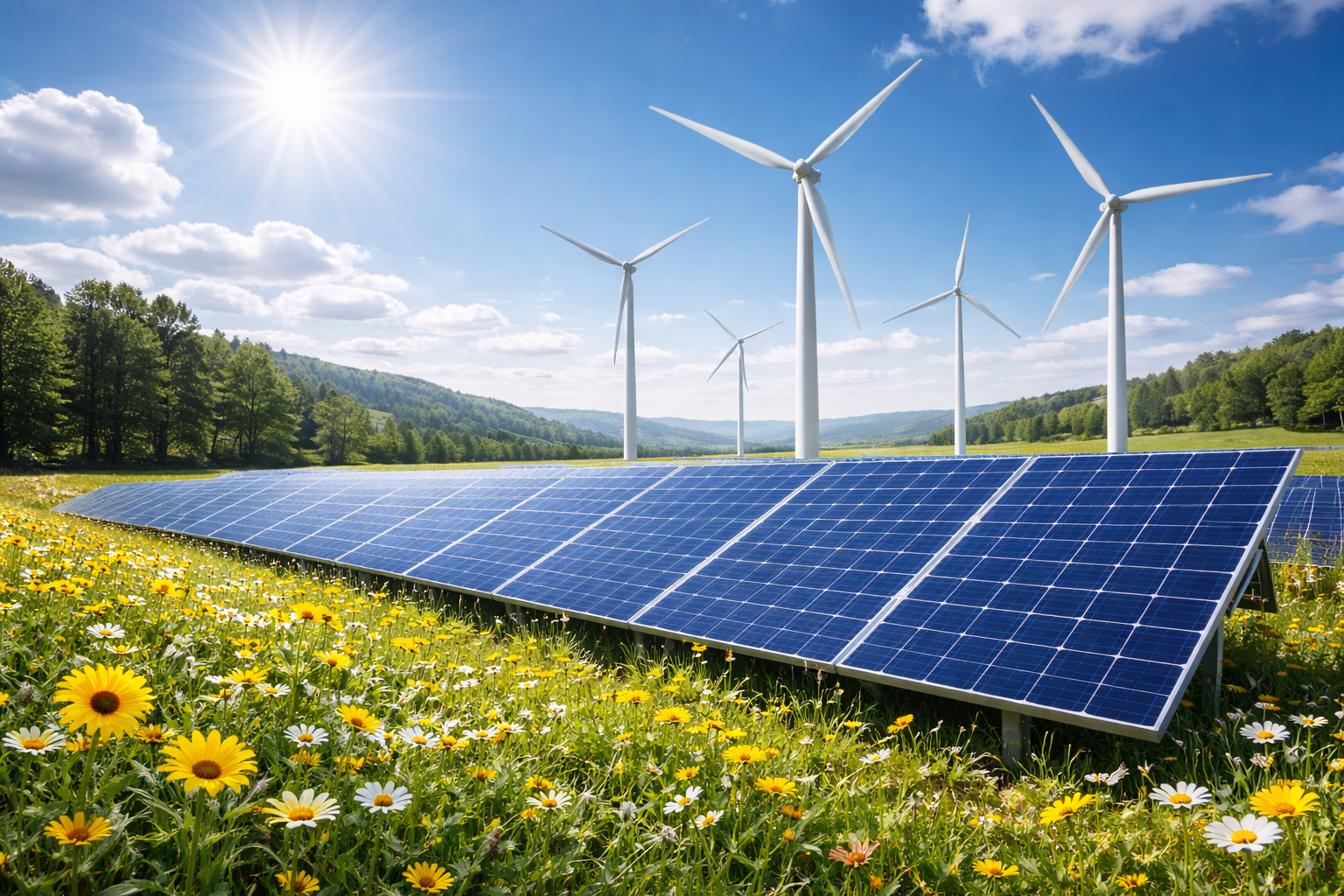
Renewable energy is energy generated from natural sources that are continuously replenished on a human timescale. These sources — including sunlight, wind, water, geothermal heat, and biological materials — do not run out when managed sustainably. Renewable systems convert naturally occurring energy flows into electricity, heat, or fuel with significantly lower greenhouse gas emissions than fossil fuels.
Unlike coal, oil, and natural gas, which are finite and carbon-intensive, renewable energy relies on ongoing natural processes. Because these sources regenerate naturally, they support long-term energy production while reducing environmental impact. Renewable energy is a central component of global efforts to improve energy security, reduce pollution, and limit climate change.
At a systems level, renewable energy integrates generation technologies, storage solutions, and grid infrastructure to deliver reliable power. While availability varies by geography and weather patterns, advances in energy storage, forecasting, and grid management are improving consistency and scalability.
Ready Facts:
- Renewable energy comes from sources that naturally replenish
- Solar, wind, water, geothermal, and biomass are primary examples
- Operational greenhouse gas emissions are much lower than fossil fuels
- Renewable systems support long-term energy sustainability
- Grid integration and storage improve reliability
Key Characteristics of Renewable Energy:
- Derived from continuously replenishing natural processes
- Produces low or near-zero operational emissions
- Supports sustainable long-term energy supply
- Can operate at small or utility scale
- Reduces dependence on finite fossil fuels
Renewable vs Non-Renewable Energy — Core Differences:
| Feature | Renewable Energy | Non-Renewable Energy |
| Source availability | Naturally replenished | Finite reserves |
| Emissions | Low to minimal | High greenhouse gas emissions |
| Sustainability | Long-term | Depletes over time |
| Environmental impact | Generally lower | Higher pollution and ecosystem impact |
| Energy security | Diversified supply | Dependent on fuel reserves |
Summary — Renewable Energy:
Renewable energy is produced from naturally replenishing sources that provide sustainable power with lower emissions. It supports long-term energy security, environmental protection, and modern grid reliability.
Key Takeaways:
- Renewable energy relies on continuously replenished natural sources
- It produces far fewer emissions than fossil fuels
- It enables long-term sustainable energy production
- Modern grids integrate renewables with storage and smart management
Pros and Limitations:
| Aspect | Advantages | Limitations |
| Environmental impact | Low emissions and pollution | Manufacturing footprint exists |
| Sustainability | Long-term resource availability | Dependent on natural variability |
| Energy security | Diversifies energy supply | Requires grid upgrades |
| Scalability | Suitable for many regions | Infrastructure investment needed |
Common Misconceptions:
| Misconception | Clarification |
| Renewable energy has zero environmental impact | Infrastructure production and land use still require management |
| Renewables are unreliable | Storage and smart grid systems improve consistency |
| Only large economies can use renewables | Systems scale from homes to national grids |
also read: What Is Global Warming? Definition, Evidence, Health & Climate Impacts.
Types of Renewable Energy:
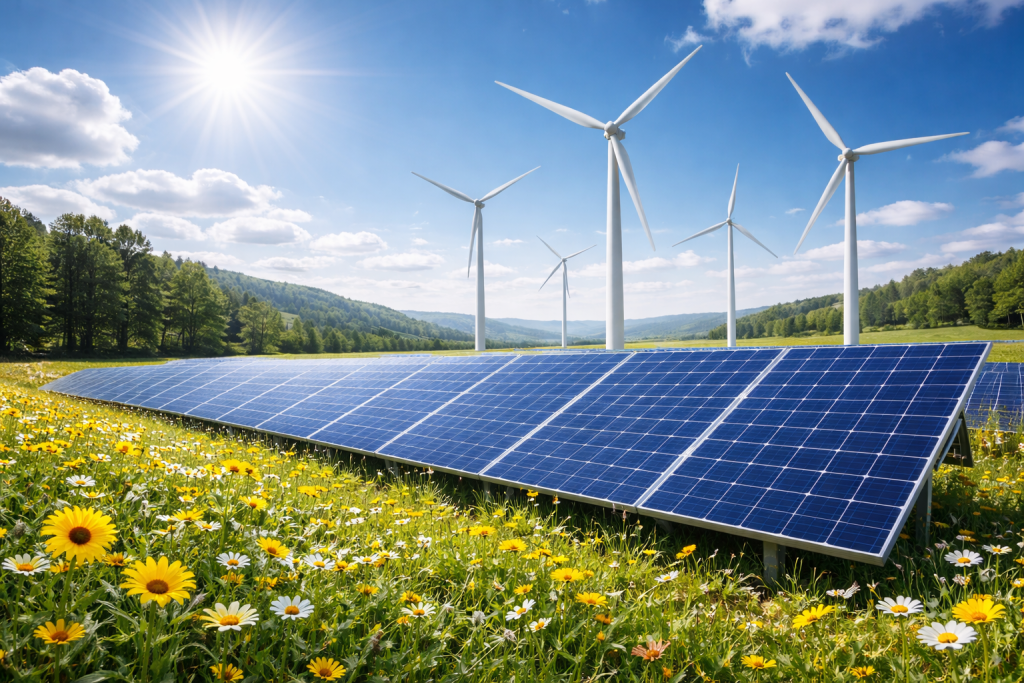
Renewable energy comes from multiple natural sources, each using different technologies to convert environmental energy into usable electricity or heat. These sources vary in availability, scalability, and application, allowing countries and communities to diversify energy production while reducing greenhouse gas emissions.
Understanding the major types of renewable energy helps explain how modern energy systems balance sustainability, reliability, and cost.
Solar Energy:
Solar energy captures sunlight and converts it into electricity or heat. Photovoltaic (PV) panels generate electricity directly from sunlight, while solar thermal systems use heat for power generation or water heating. Solar technology is scalable, ranging from rooftop installations to large solar farms.
Wind Energy:
Wind energy converts the kinetic energy of moving air into electricity using turbines. Onshore wind farms operate on land, while offshore installations benefit from stronger and more consistent winds. Wind power is one of the fastest-growing renewable energy sources globally.
Hydropower:
Hydropower generates electricity by using flowing or falling water to spin turbines. Large dams provide substantial power capacity, while small-scale or micro-hydro systems serve local communities. Hydropower also supports grid stability due to its controllable output.
Geothermal Energy:
Geothermal energy uses heat from beneath the Earth’s surface to generate electricity or provide direct heating. This source delivers consistent energy output and is especially effective in geologically active regions.
Biomass and Bioenergy:
Biomass energy comes from organic materials such as plant waste, wood, and agricultural residues. These materials can be burned directly for heat or converted into biofuels. When managed sustainably, biomass can provide renewable energy with balanced carbon cycles.
Ready Facts:
- Solar energy converts sunlight directly into electricity or heat
- Wind turbines generate power from moving air
- Hydropower uses flowing water to produce electricity
- Geothermal systems harness underground heat
- Biomass converts organic material into usable energy
Comparison of Renewable Energy Types:
| Energy Type | Primary Source | Main Use | Reliability | Scalability |
| Solar | Sunlight | Electricity, heating | Variable | Highly scalable |
| Wind | Air movement | Electricity | Variable | Utility-scale |
| Hydropower | Flowing water | Electricity | High | Large to local |
| Geothermal | Earth heat | Electricity, heating | Very high | Location-dependent |
| Biomass | Organic material | Heat, fuel, electricity | Moderate | Flexible |
Summary — Types of Renewable Energy:
Renewable energy includes solar, wind, hydropower, geothermal, and biomass systems. Each source uses natural processes to generate sustainable power, enabling diversified and low-emission energy production.
Key Takeaways:
- Multiple renewable sources support energy diversification
- Each energy type has unique strengths and limitations
- Combining sources improves grid stability
- Renewable technologies scale from local to national systems
Pros and Limitations:
| Energy Type | Advantages | Limitations |
| Solar | Abundant, scalable | Weather-dependent |
| Wind | High output potential | Variable generation |
| Hydropower | Reliable, controllable | Environmental impacts |
| Geothermal | Consistent energy | Geographic limitations |
| Biomass | Flexible fuel source | Requires sustainable management |
Common Misconceptions:
| Misconception | Clarification |
| One renewable source can power everything | Energy systems work best when diversified |
| Solar and wind are always unreliable | Storage and grid management improve consistency |
| Biomass is automatically carbon neutral | Sustainability depends on sourcing and management |
How Renewable Energy Works:
Renewable energy systems convert naturally occurring energy flows into electricity, heat, or fuel using specialized technologies. Each renewable source relies on a physical process — such as light absorption, air movement, or heat transfer — to generate usable energy. These systems are connected to electrical grids or local distribution networks, allowing energy to be stored, managed, and delivered reliably.
Unlike conventional power plants that burn fuel to create heat, renewable technologies capture existing environmental energy. This reduces emissions while enabling sustainable generation. Modern renewable infrastructure combines generation equipment, power electronics, storage systems, and smart grid controls to balance supply and demand.
Energy Conversion Processes:
Renewable energy technologies transform natural forces into usable power through mechanical, thermal, or electrical conversion.
- Solar panels convert sunlight into electrical current using photovoltaic cells
- Wind turbines convert moving air into rotational energy that drives generators
- Hydropower systems use flowing water to spin turbines
- Geothermal plants convert underground heat into steam for power generation
- Biomass systems release stored chemical energy through controlled combustion or processing
Grid Integration:
Electricity from renewable sources must be synchronized with the power grid. Grid integration involves inverters, transformers, and digital controls that stabilize voltage and frequency. Smart grid technologies monitor supply conditions and distribute electricity efficiently, helping manage variability from weather-dependent sources.
Energy Storage Technologies:
Energy storage ensures renewable electricity remains available when production fluctuates. Batteries, pumped hydro storage, thermal storage, and emerging technologies capture excess energy and release it when needed, improving grid reliability and resilience.
Ready Facts:
- Renewable systems convert natural forces into electricity or heat
- Solar panels generate power using photovoltaic conversion
- Wind and water energy rely on turbine-driven generators
- Smart grids balance renewable supply and demand
- Energy storage improves reliability during variable production
Renewable Energy Conversion Overview:
| Energy Source | Conversion Method | Output Form |
| Solar | Photovoltaic effect | Electricity |
| Wind | Mechanical turbine rotation | Electricity |
| Hydropower | Water-driven turbines | Electricity |
| Geothermal | Heat-to-steam conversion | Electricity / heating |
| Biomass | Combustion or processing | Heat / fuel / electricity |
Summary — How Renewable Energy Works:
Renewable energy systems convert natural environmental forces into electricity or heat using turbines, photovoltaic cells, and thermal processes. Grid integration and energy storage ensure reliable delivery despite variable generation.
Key Takeaways:
- Renewable energy relies on natural energy conversion processes
- Grid technology stabilizes renewable electricity supply
- Storage systems improve reliability and flexibility
- Modern infrastructure supports scalable renewable integration
Pros and Limitations:
| Aspect | Advantages | Limitations |
| Energy conversion | Low emissions | Variable output from some sources |
| Grid integration | Supports clean power delivery | Requires infrastructure upgrades |
| Storage systems | Improves reliability | Cost and technology maturity vary |
Common Misconceptions:
| Misconception | Clarification |
| Renewable energy cannot power grids reliably | Storage and smart grids enable stable supply |
| Conversion processes are inefficient | Technology improvements continue increasing efficiency |
| Storage is optional | Reliable renewable systems benefit from energy storage |
Environmental Benefits of Renewable Energy:
Renewable energy reduces environmental impact by replacing fossil fuel combustion with low-emission energy generation. Because renewable systems rely on naturally replenishing resources, they significantly lower greenhouse gas emissions, air pollutants, and ecosystem damage associated with extraction and fuel burning.
Environmental benefits extend beyond climate mitigation. Renewable energy reduces water consumption, limits habitat disruption compared to mining and drilling, and improves air quality. When deployed responsibly, renewable infrastructure supports long-term ecosystem stability while meeting growing energy demand.
Emission Reduction:
Fossil fuel combustion releases large quantities of carbon dioxide, methane, sulfur dioxide, and particulate matter. Renewable energy systems produce little to no direct operational emissions, making them a key tool for reducing atmospheric pollution and slowing global warming.
Resource Sustainability:
Renewable energy relies on energy flows that naturally regenerate. Unlike finite fossil fuels, renewable sources do not deplete with use, reducing pressure on land extraction, mining, and fuel transport systems.
Air and Water Quality Improvements:
Replacing fossil fuels reduces airborne pollutants linked to respiratory disease, acid rain, and smog. Renewable technologies also require less water for operation compared to conventional thermal power plants, helping conserve freshwater resources.
Ecosystem Protection:
Lower demand for fossil fuel extraction reduces land degradation, oil spills, and habitat fragmentation. While renewable infrastructure must be carefully planned, its long-term ecological footprint is generally smaller when managed sustainably.
Ready Facts:
- Renewable energy produces minimal operational greenhouse gas emissions
- Fossil fuel replacement reduces air pollution and climate impact
- Renewable systems typically use less water than thermal power plants
- Reduced extraction lowers habitat and ecosystem damage
- Sustainable deployment supports long-term environmental protection
Environmental Impact Comparison:
| Impact Area | Renewable Energy | Fossil Fuels |
| Greenhouse gas emissions | Very low operational emissions | High emissions |
| Air pollution | Minimal | Significant pollutants |
| Water consumption | Lower operational use | High cooling demand |
| Land extraction | Limited resource removal | Mining and drilling impacts |
| Ecosystem disruption | Manageable with planning | High long-term damage |
Summary — Environmental Benefits of Renewable Energy:
Renewable energy reduces emissions, improves air and water quality, conserves natural resources, and minimizes ecosystem damage. These environmental advantages support climate stability and long-term sustainability.
Key Takeaways:
- Renewable energy significantly lowers greenhouse gas emissions
- Cleaner air and water improve public and ecosystem health
- Sustainable resource use protects natural systems
- Responsible deployment minimizes environmental tradeoffs
Pros and Limitations:
| Aspect | Advantages | Limitations |
| Emissions | Major reduction in pollutants | Manufacturing footprint exists |
| Water use | Lower operational demand | Site-specific requirements vary |
| Land impact | Reduced extraction damage | Infrastructure planning needed |
Common Misconceptions:
| Misconception | Clarification |
| Renewable energy has zero environmental impact | Infrastructure production and land use still require management |
| All renewables are automatically eco-friendly | Proper siting and lifecycle planning are essential |
| Fossil fuels are comparable in impact | Long-term pollution and extraction damage are significantly higher |
Economic and Social Impacts of Renewable Energy:
Renewable energy influences economies and societies by reshaping how energy is produced, distributed, and consumed. Investment in renewable technologies supports job creation, strengthens energy security, stabilizes long-term energy costs, and promotes regional development. As energy systems transition away from fossil fuels, renewable industries play an increasingly important role in economic resilience and social well-being.
Beyond direct economic activity, renewable energy improves public health by reducing pollution and expands electricity access in underserved areas. These social benefits contribute to sustainable development while supporting modern infrastructure growth.
Job Creation and Workforce Development:
Renewable energy industries create employment in manufacturing, installation, operations, maintenance, research, and grid management. Jobs often span technical, engineering, and skilled labor sectors, supporting workforce diversification and regional economic growth.
Energy Security and Independence:
Diversifying energy sources reduces dependence on imported fuels and volatile fossil fuel markets. Domestic renewable generation strengthens national energy resilience and reduces exposure to supply disruptions.
Cost Trends and Affordability:
Technological advances and economies of scale have significantly lowered the cost of renewable electricity. Stable operating costs and minimal fuel expenses contribute to predictable long-term pricing, supporting energy affordability.
Infrastructure and Community Development:
Renewable energy projects stimulate infrastructure investment, rural development, and grid modernization. Local energy generation can enhance community resilience and expand access to reliable electricity.
Ready Facts:
- Renewable energy industries support millions of jobs globally
- Domestic renewable generation improves energy independence
- Falling technology costs increase affordability
- Renewable projects stimulate infrastructure investment
- Cleaner energy reduces public health costs linked to pollution
Economic Impact Overview:
| Impact Area | Renewable Energy Effect |
| Employment | Expands technical and skilled job markets |
| Energy pricing | Improves long-term cost stability |
| Infrastructure | Encourages modernization and regional investment |
| Energy security | Reduces reliance on imported fuels |
| Public health | Lowers pollution-related economic burdens |
Summary — Economic and Social Impacts:
Renewable energy strengthens economies through job creation, stable energy costs, and infrastructure investment while improving energy security and public health. These benefits support long-term social and economic resilience.
Key Takeaways:
- Renewable energy drives job growth and workforce development
- Diversified energy supply improves national resilience
- Falling costs enhance long-term affordability
- Infrastructure investment supports community development
Pros and Limitations:
| Aspect | Advantages | Limitations |
| Employment | Expanding job markets | Workforce retraining may be required |
| Energy pricing | Stable long-term costs | Upfront infrastructure investment needed |
| Development | Regional economic growth | Policy and planning coordination required |
Common Misconceptions:
| Misconception | Clarification |
| Renewable energy harms economic growth | It creates jobs and investment opportunities |
| Clean energy is always more expensive | Costs have declined significantly in many regions |
| Energy transitions only affect utilities | Broader infrastructure and workforce sectors are involved |
Challenges and Limitations of Renewable Energy:
While renewable energy offers significant environmental and economic benefits, it also faces technical, economic, and operational challenges. Understanding these limitations is crucial for developing strategies that ensure reliable, scalable, and cost-effective energy systems.
Intermittency:
Some renewable sources, such as solar and wind, are dependent on weather and time of day, leading to variable electricity output. Without storage or grid management, this intermittency can create supply gaps, especially during peak demand periods.
Energy Storage Needs:
To address intermittency, energy storage systems like batteries, pumped hydro, or thermal storage are required. While technology is advancing, storage solutions can be expensive and require careful planning to match generation patterns with demand.
Grid Modernization:
Integrating large-scale renewable energy into existing power grids requires upgrades to transmission infrastructure, smart controls, and balancing systems. Legacy grids may not handle variable power effectively, necessitating investment and innovation.
Land and Resource Use:
Renewable infrastructure, including solar farms, wind turbines, and hydro facilities, requires land and resources. Improper siting can impact ecosystems, biodiversity, and local communities. Sustainable planning is essential to minimize negative effects.
Ready Facts:
- Solar and wind energy are variable and depend on weather conditions
- Energy storage is essential for consistent electricity supply
- Grid upgrades are necessary to accommodate high renewable penetration
- Land and resource planning mitigate environmental and social impacts
- Technological and financial innovation is improving system reliability
Challenges Overview:
| Challenge | Description |
| Intermittency | Solar and wind output fluctuates with weather and time |
| Energy storage | Required to ensure continuous supply, adds cost |
| Grid modernization | Upgrades needed for variable renewable integration |
| Land use | Infrastructure impacts ecosystems and communities |
| Initial costs | Upfront investment can be significant |
Summary — Challenges and Limitations:
Renewable energy systems face intermittency, storage, grid, and land-use challenges. Addressing these limitations through technology, planning, and investment ensures reliable, scalable, and sustainable energy deployment.
Key Takeaways:
- Intermittency requires storage and grid management
- Grid modernization is critical for large-scale adoption
- Land and resource planning reduce environmental and social impact
- Initial infrastructure costs can be offset by long-term benefits
Common Misconceptions:
| Misconception | Clarification |
| Renewable energy is always reliable | Variable sources require storage and management |
| Challenges make renewables impractical | Solutions exist through storage, smart grids, and planning |
| Land use impacts cannot be minimized | Proper siting and multi-use planning mitigate effects |
Renewable Energy Adoption Worldwide:
The adoption of renewable energy has accelerated globally, driven by climate commitments, technological advancements, and decreasing costs. Countries are deploying solar, wind, hydropower, geothermal, and biomass systems to diversify energy supply, reduce greenhouse gas emissions, and strengthen energy security.
Global adoption varies by region, reflecting resource availability, policy frameworks, and economic conditions. While some nations lead in capacity installation, others are rapidly expanding renewable infrastructure to meet growing demand and sustainability goals.
Regional Adoption Trends:
- Europe: Leading in wind and solar deployment, with ambitious carbon-neutral targets
- China: Largest global renewable capacity, especially in solar and hydropower
- United States: Rapid growth in solar, wind, and distributed generation systems
- India: Focused on solar expansion and rural electrification
- Africa & Latin America: Emerging markets for solar, wind, and micro-hydro projects
Policy Drivers:
Government policies and incentives are key to adoption, including feed-in tariffs, tax credits, renewable portfolio standards, and public-private partnerships. Regulatory frameworks, investment support, and long-term planning accelerate renewable energy deployment.
Technological Innovation:
Advances in energy storage, grid integration, and renewable generation efficiency improve reliability and scalability. Digital tools, forecasting models, and smart grid technologies enhance renewable energy management.
Ready Facts:
- Global renewable capacity exceeds 3,000 GW and continues growing
- China, the US, and Europe lead in installed capacity
- Policy incentives significantly boost adoption rates
- Technological improvements reduce costs and improve reliability
- Developing regions increasingly rely on distributed renewable systems
Global Adoption Overview:
| Region | Leading Renewable Sources | Notable Trends |
| Europe | Wind, Solar | Aggressive decarbonization targets |
| China | Solar, Hydropower | Largest global capacity |
| United States | Solar, Wind | Rapid distributed generation growth |
| India | Solar, Wind | Rural electrification focus |
| Africa & Latin America | Solar, Micro-hydro | Emerging markets, off-grid solutions |
Summary — Renewable Energy Adoption Worldwide:
Renewable energy adoption is expanding globally, led by regions with strong policy support, abundant resources, and technological innovation. Widespread deployment enhances energy security, reduces emissions, and supports sustainable development.
Key Takeaways:
- Adoption rates vary by region due to resources, policy, and economics
- Policy incentives and international agreements drive growth
- Technological advancements improve efficiency, reliability, and scalability
- Developing regions increasingly access decentralized renewable energy
Common Misconceptions:
| Misconception | Clarification |
| Only wealthy nations can adopt renewables | Emerging economies are rapidly implementing renewable systems |
| Adoption is slow globally | Capacity installation has grown exponentially in the last decade |
| Technology alone drives adoption | Policies, incentives, and finance are equally critical |
Future of Renewable Energy:
The future of renewable energy is shaped by technological innovation, policy frameworks, and global efforts to decarbonize energy systems. Advancements in generation, storage, and grid integration are making renewable energy more reliable, efficient, and scalable. Emerging technologies, such as floating solar, offshore wind, advanced batteries, and green hydrogen, are expanding the potential of clean energy.
Global energy systems are transitioning toward a combination of decentralized and utility-scale renewable solutions, supported by smart grids and digital energy management. Ambitious international climate targets and net-zero commitments are driving investment and innovation, ensuring that renewable energy will play a dominant role in the world’s energy mix.
Emerging Technologies:
- Floating solar: Solar panels installed on water surfaces, reducing land use and improving efficiency
- Offshore wind: Exploiting strong, consistent winds for high-capacity generation
- Advanced energy storage: Longer-duration batteries, thermal storage, and hydrogen for grid reliability
- Green hydrogen: Renewable-powered hydrogen production for fuel and industrial use
Decarbonization Pathways:
Renewable energy adoption is central to achieving net-zero emissions. Combining multiple energy sources, enhancing efficiency, and integrating storage and smart grids enables countries to reduce reliance on fossil fuels while meeting growing electricity demand.
Economic and Social Implications:
Future renewable energy systems will continue to create jobs, strengthen energy security, and lower long-term energy costs. Technological advancements and supportive policies will ensure that benefits are accessible across developed and developing regions.
Ready Facts:
- Global renewable energy capacity is expected to continue growing rapidly through 2050
- Technological innovations like offshore wind, floating solar, and energy storage will expand generation potential
- Renewable energy is central to achieving net-zero emission targets
- Smart grids and energy management systems improve reliability and integration
- Investment in clean energy drives economic growth and social benefits
Future Renewable Energy Overview:
| Focus Area | Emerging Trends |
| Solar | Floating panels, higher efficiency modules |
| Wind | Offshore installations, larger turbines |
| Storage | Long-duration batteries, pumped hydro, hydrogen storage |
| Grid Integration | Smart grids, digital energy management |
| Policy & Investment | Net-zero targets, international incentives |
Summary — Future of Renewable Energy:
The future of renewable energy relies on technological innovation, integrated grids, and international climate action. Emerging technologies and decarbonization strategies will expand renewable capacity, improve reliability, and enhance economic and social benefits worldwide.
Key Takeaways:
- Technological innovations will increase generation efficiency and scalability
- Renewable energy is essential for achieving global net-zero emissions
- Smart grids and storage improve system reliability and flexibility
- Economic growth, energy security, and social benefits are linked to renewable expansion
Common Misconceptions:
| Misconception | Clarification |
| Renewable energy will replace fossil fuels immediately | Transition requires planning, infrastructure, and gradual integration |
| Technology alone ensures the future of renewables | Policies, investment, and societal adoption are equally critical |
| Renewable growth is only for wealthy nations | Emerging economies are rapidly increasing adoption and innovation |
Conclusion:
Renewable energy is transforming the global energy landscape by providing sustainable, low-emission alternatives to fossil fuels. Sources such as solar, wind, hydropower, geothermal, and biomass offer reliable energy while reducing greenhouse gas emissions, protecting ecosystems, and improving public health.
Economic and social benefits include job creation, energy security, infrastructure development, and stable long-term energy costs. While challenges such as intermittency, storage, grid integration, and land use exist, technological advancements and smart policy frameworks are addressing these limitations.
Global adoption is accelerating, driven by falling costs, international climate targets, and innovative technologies. The future of renewable energy depends on continued investment, technological innovation, and coordinated efforts to achieve a sustainable, decarbonized energy system worldwide. Renewable energy is not only an environmental necessity but also a driver of economic growth, energy security, and long-term societal resilience.
Frequently Asked Questions (FAQs)
What is renewable energy?
Renewable energy is energy derived from natural sources that are continuously replenished, such as sunlight, wind, water, geothermal heat, and biomass.
What are the main types of renewable energy?
The major types include solar, wind, hydropower, geothermal, and biomass energy, each using different technologies to generate electricity or heat.
Why is renewable energy important?
It reduces greenhouse gas emissions, protects ecosystems, improves air and water quality, and provides long-term energy sustainability.
What are the challenges of renewable energy?
Challenges include intermittency, energy storage needs, grid integration, land use, and upfront infrastructure costs.
How is renewable energy adopted worldwide?
Adoption varies by region, driven by natural resources, policies, economic conditions, and technological availability. Leading regions include Europe, China, the US, and emerging markets in India, Africa, and Latin America.
What is the future of renewable energy?
Future growth depends on technological innovations, smart grid integration, energy storage solutions, and international climate commitments. Emerging technologies include offshore wind, floating solar, advanced batteries, and green hydrogen.
Can renewable energy completely replace fossil fuels?
Renewables can provide a majority of energy needs with proper infrastructure, storage, and diversified energy systems, but a complete transition requires careful planning and phased implementation.
References:
- International Energy Agency (IEA). Renewables 2023: Market Report. https://www.iea.org/reports/renewables-2023
- International Renewable Energy Agency (IRENA). Renewable Capacity Statistics 2023. https://www.irena.org/Statistics
.