
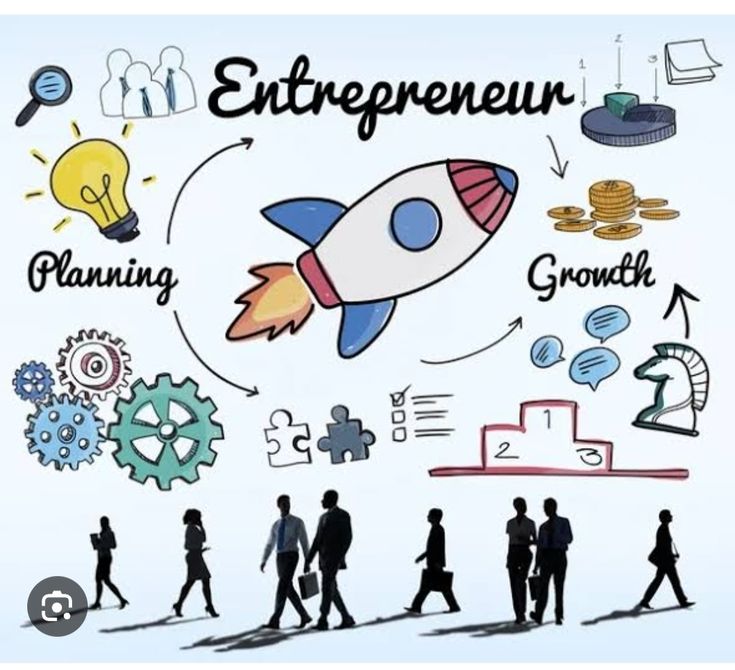
Entrepreneurship is the process of identifying opportunities, creating innovative solutions, and organizing resources to start and grow a business while assuming financial, operational, and market risk. It focuses on value creation, innovation, and long-term economic impact rather than routine business operations.
According to established economic theory, It involves innovation, risk-taking, and the transformation of ideas into viable economic activities.
Meaning of Entrepreneurship in Business and Economics
In business, entrepreneurship refers to launching and managing new ventures that introduce products, services, or business models to meet market needs.
In economics, It is viewed as a driver of economic growth, responsible for:
- Introducing innovation
- Increasing productivity
- Creating employment
- Stimulating competition
Economist Joseph Schumpeter defined entrepreneurship as a force of “creative destruction,” where new innovations replace outdated systems and industries.
Core Elements of Entrepreneurship
- Opportunity Recognition – Identifying unmet market needs
- Innovation – Creating new or improved solutions
- Risk Management – Accepting uncertainty in outcomes
- Resource Coordination – Combining capital, labor, and technology
- Value Creation – Delivering economic or social benefits
These elements distinguish entrepreneurship from traditional employment and routine business ownership.
Summary Box
It is a structured process of transforming ideas into sustainable ventures through innovation, calculated risk-taking, and efficient resource management, contributing directly to business development and economic progress.
Key Takeaways
- It centers on innovation and opportunity creation
- It plays a critical role in economic development
- Entrepreneurs assume risk to create value and growth
- It applies to startups, SMEs, and scalable ventures.
Facts
- It involves innovation, opportunity recognition, and risk-taking
- Entrepreneurs create value by introducing new products or services
- It contributes to job creation and economic growth
Who Is an Entrepreneur
Definition of an Entrepreneur
An entrepreneur is an individual who identifies business opportunities, develops innovative solutions, and organizes resources to create and manage a venture while bearing financial and operational risk. Entrepreneurs act as decision-makers and value creators within an economy.
Based on widely accepted business definitions, entrepreneurs combine innovation, initiative, and risk management to transform ideas into economic activity.
Role of an Entrepreneur
The entrepreneur plays a central role in the entrepreneurial ecosystem by:
- Identifying unmet market needs
- Introducing new products, services, or business models
- Mobilizing capital, labor, and technology
- Making strategic and operational decisions
- Driving innovation and competitive advantage
In economic terms, entrepreneurs act as catalysts for growth, improving productivity and market efficiency.
Key Responsibilities of Entrepreneurs
| Responsibility | Description |
| Opportunity Evaluation | Assessing feasibility and market demand |
| Strategic Planning | Defining business goals and growth direction |
| Resource Management | Allocating financial, human, and technical resources |
| Risk Management | Managing uncertainty and potential losses |
| Execution | Implementing plans and scaling operations |
Entrepreneur vs Manager (Conceptual Distinction)
- Entrepreneurs focus on opportunity creation and innovation
- Managers focus on efficiency, stability, and execution within established systems
This distinction highlights why entrepreneur is associated with change and growth, while management emphasizes control and optimization.
Summary Box
An entrepreneur is a proactive individual who initiates and leads business ventures by recognizing opportunities, innovating solutions, and assuming calculated risks to create economic or social value.
Key Takeaways
- Entrepreneurs are opportunity-driven innovators
- They assume financial and market risk
- Their role extends beyond ownership to strategic leadership
- Entrepreneurs contribute directly to economic development and innovation
Common Misconceptions
- ❌ Entrepreneurs are born, not made
- ❌ Entrepreneurs only work alone
- ❌ Entrepreneurs are the same as managers
In practice, entrepreneurial skills can be developed, and most entrepreneurs operate within teams and structured ecosystems.
Discover the best selling perfumes in Pakistan, featuring top fragrances for both men and women that are loved for their long-lasting scent, premium quality, and wide appeal. From fresh and woody notes for men to floral and oriental blends for women, these popular perfumes reflect current fragrance trends and personal style preferences across Pakistan.
Facts
- An entrepreneur identifies opportunities and creates value through innovation
- Entrepreneurs assume risk to introduce new economic activities
- Entrepreneurs play a key role in job creation and economic growth
- Entrepreneurs play a key role in job creation and economic growth
Types of Entrepreneurship
It exists in multiple forms, each defined by its objective, scale, innovation level, and impact. Understanding these types helps explain how entrepreneurial activity operates across different economic and business environments.
Small Business Entrepreneurship
Small business entrepreneurship focuses on establishing and operating locally based businesses that serve a specific market. These ventures prioritize stable income and long-term sustainability rather than rapid expansion.
Key characteristics:
- Limited operational scale
- Owner-managed structure
- Local or regional customer base
- Moderate growth expectations
This type is common among retail stores, service providers, and family-owned enterprises.
Scalable Startup Entrepreneurship
Scalable startup is driven by innovation and rapid growth. These ventures aim to expand quickly, often through technology, investment funding, and global markets.
Key characteristics:
- High-growth business models
- Focus on innovation and scalability
- External funding from investors
- National or international market reach
Startups in technology and digital platforms commonly follow this model.
Social Entrepreneurship
Social entrepreneurship prioritizes social or environmental impact alongside financial sustainability. The primary goal is solving societal problems rather than maximizing profit.
Key characteristics:
- Mission-driven objectives
- Measurable social impact
- Sustainable revenue models
- Alignment with social development goals
Examples include ventures addressing education, healthcare, and environmental challenges.
Corporate Entrepreneurship (Intrapreneurship)
Corporate entrepreneurship occurs within established organizations where employees act as intrapreneurs to develop new products, services, or processes.
Key characteristics:
- Innovation within existing companies
- Organizational support and resources
- Lower individual financial risk
- Focus on competitive advantage
Innovative and Digital Entrepreneurship
Innovative and digital entrepreneurship leverages technology, data, and digital platforms to create new business models or disrupt traditional industries.
Key characteristics:
- Technology-driven solutions
- Online or platform-based operations
- Global reach with low entry barriers
- Rapid adaptation to market changes
Types of Entrepreneurship Comparison Table
| Type | Primary Objective | Scale | Risk Level |
| Small Business | Stable income | Local | Moderate |
| Scalable Startup | Rapid growth | Global | High |
| Social | Social impact | Variable | Moderate |
| Corporate | Organizational innovation | Large firms | Low |
| Digital/Innovative | Market disruption | Global | High |
Summary Box
Types of entrepreneurship vary based on purpose, growth ambition, and innovation level, ranging from small local businesses to scalable startups and socially driven ventures.
Key Takeaways
- It is not a single model
- Different types serve different economic and social roles
- Innovation and scalability define startup entrepreneurship
- Social and corporate entrepreneurship expand impact beyond profit
Common Misconceptions
- ❌ All entrepreneurs aim for rapid growth
- ❌ It is limited to startups
- ❌ Social entrepreneurship is non-profit only
Each type of entrepreneurship operates with distinct goals and success metrics.
FACTS
It includes small business, startup, social, corporate, and digital forms
- Each type differs in scale, risk, and objective
- Innovation and purpose define the entrepreneurial approach
Entrepreneurial Process
The entrepreneurial process is a structured sequence of actions through which entrepreneurs transform ideas into operational and scalable ventures. It emphasizes opportunity evaluation, planning, execution, and growth management.
Idea Generation and Opportunity Recognition
It begins with identifying market gaps, problems, or unmet needs. Opportunities may arise from technological change, consumer behavior shifts, or inefficiencies in existing markets.
Key activities include:
- Observing customer pain points
- Analyzing industry trends
- Identifying innovative solutions
- Evaluating feasibility and demand
Market Research and Validation
Market research validates whether an entrepreneurial idea has commercial potential. This stage reduces uncertainty and informs strategic decisions.
Core components:
- Target market identification
- Customer demand analysis
- Competitive landscape assessment
- Pricing and value proposition testing
Effective validation minimizes risk before major resource commitment.
Business Planning
Business planning converts validated ideas into a formal roadmap. It defines objectives, strategies, and financial expectations.
Typical elements include:
- Business model and revenue streams
- Marketing and operations strategy
- Cost structure and budgeting
- Risk assessment and mitigation
Resource Mobilization
At this stage, entrepreneurs acquire and organize the resources required to operate.
Resources include:
- Financial capital
- Human resources
- Technology and infrastructure
- Supplier and partner networks
Business Launch and Growth
The final stage involves market entry and scaling. Entrepreneurs monitor performance, adapt strategies, and pursue sustainable growth.
Growth activities include:
- Product or service optimization
- Market expansion
- Process improvement
- Performance measurement
Entrepreneurial Process Table
| Step | Description |
| Opportunity Recognition | Identifying viable business ideas |
| Market Validation | Testing demand and feasibility |
| Planning | Developing strategic and financial plans |
| Resource Mobilization | Securing capital and talent |
| Launch and Growth | Operating and scaling the business |
Summary Box
The entrepreneurial process is a systematic pathway that guides entrepreneurs from idea identification to business growth, reducing risk through validation and strategic planning.
Key Takeaways
- It follows a structured process
- Market validation is critical to reducing failure risk
- Planning aligns resources with objectives
Facts
- The entrepreneurial process includes idea generation, validation, planning, and growth
- Market research reduces uncertainty
- Resource coordination is essential for execution
Characteristics and Skills of Successful Entrepreneurs
Successful entrepreneur depends on a combination of personal characteristics and practical skills that enable individuals to identify opportunities, manage risk, and sustain business growth.
Core Entrepreneurial Traits
Entrepreneurial traits are behavioral qualities that influence decision-making and leadership effectiveness.
Key characteristics include:
- Innovative mindset – Ability to generate and apply new ideas
- Risk tolerance – Willingness to operate under uncertainty
- Resilience – Capacity to recover from failure or setbacks
- Proactiveness – Initiative in identifying and acting on opportunities
- Adaptability – Flexibility in response to market and environmental changes
These traits support long-term entrepreneurial sustainability.
Essential Entrepreneurial Skills
Entrepreneurial skills are learnable competencies required to execute business activities effectively.
Core skills include:
- Strategic planning – Setting goals and defining growth direction
- Financial management – Budgeting, cash flow control, and cost analysis
- Marketing and sales – Customer acquisition and value communication
- Leadership and communication – Team coordination and stakeholder management
- Problem-solving – Identifying and addressing operational challenges
Traits vs Skills Comparison
| Aspect | Traits | Skills |
| Nature | Behavioral qualities | Practical competencies |
| Development | Partially innate | Fully learnable |
| Role | Influence mindset | Enable execution |
| Impact | Long-term resilience | Operational performance |
Summary Box
Successful entrepreneurs combine innovative traits with developed skills, enabling them to manage uncertainty, lead teams, and create sustainable business value.
Key Takeaways
- Entrepreneurial success requires both traits and skills
- Skills can be developed through education and experience
- Adaptability and resilience support long-term performance
- Strategic and financial skills are critical for growth
Common Misconceptions
- ❌ Entrepreneurs must be born with talent
- ❌ Skills alone guarantee success
- ❌ Risk-taking means ignoring planning
In practice, It balances mindset, skill development, and strategic discipline.
Facts
- Entrepreneurs need both behavioral traits and practical skills
- Entrepreneurial skills can be learned and improved
- Adaptability and leadership are key success factors
Importance of Entrepreneurship
It plays a critical role in economic development, innovation, and social progress. It influences how economies grow, industries evolve, and societies address emerging challenges.
Role of Entrepreneurship in Economic Growth
It contributes directly to economic expansion by creating new businesses, increasing productivity, and introducing innovative solutions.
Key economic contributions include:
- Expansion of goods and services markets
- Increased national income and GDP growth
- Efficient use of resources
- Promotion of competitive market structures
According to established economic frameworks, entrepreneurial activity is a primary driver of long-term economic growth.
Innovation and Technological Advancement
It accelerates innovation by transforming ideas into commercial applications.
Innovation outcomes include:
- Development of new products and services
- Improvement of existing technologies
- Adoption of efficient business processes
- Digital and technological transformation
Innovative entrepreneur increases productivity and strengthens industrial competitiveness.
Social and Community Development
It also contributes to social progress by addressing unmet societal needs.
Social impact areas include:
- Access to essential services
- Community development initiatives
- Social and environmental problem-solving
- Inclusive economic participation
Social entrepreneurship, in particular, aligns economic activity with social value creation.
Importance of Entrepreneurship Table
| Area | Contribution |
| Economy | GDP growth and productivity |
| Employment | Job creation and skill development |
| Innovation | New products and technologies |
| Society | Social impact and inclusion |
Summary Box
It is essential for economic growth, job creation, innovation, and social development, making it a foundational component of modern economies.
Key Takeaways
- It stimulates economic and industrial growth
- It is a major source of employment generation
- Innovation is driven by entrepreneurial activity
- Social entrepreneurship enhances community well-being
Common Misconceptions
- ❌ It only benefits business owners
- ❌ Economic growth occurs without innovation
- ❌ Social impact and profit cannot coexist
In reality, It delivers broad economic and social value.
Facts
- It drives economic growth and productivity
- Entrepreneurs create jobs and introduce innovation
- It supports both economic and social development
Advantages and Disadvantages of Entrepreneurship
Entrepreneur offers significant economic and personal benefits, but it also involves financial, operational, and market-related risks. A balanced understanding is essential for informed decision-making.
Benefits of Entrepreneurship
It provides advantages at both the individual and economic levels.
Key advantages include:
- Independence – Control over business decisions and direction
- Income potential – Opportunity for higher financial returns
- Innovation – Ability to introduce new products or services
- Economic contribution – Job creation and productivity growth
- Skill development – Continuous learning across multiple business functions
It enables individuals to create value while contributing to economic diversification.
Disadvantages and Risks of Entrepreneurship
Despite its benefits, It involves uncertainty and potential failure.
Common challenges include:
- Financial risk – Possibility of income instability or capital loss
- Market uncertainty – Changing customer demand and competition
- Workload pressure – Long working hours and high responsibility
- Resource constraints – Limited access to funding or skilled labor
- Business failure risk – High failure rates in early-stage ventures
Advantages and Disadvantages Table
| Advantages | Disadvantages |
| Business independence | Financial uncertainty |
| Innovation opportunities | High failure risk |
| Income growth potential | Work-life imbalance |
| Economic contribution | Resource limitations |
| Skill development | Market competition |
Summary Box
It offers independence, innovation, and growth opportunities, but it also requires managing risk, uncertainty, and operational challenges.
Key Takeaways
- It provides autonomy and value creation
- Financial and market risks are inherent
- Success depends on planning and risk management
- Benefits and challenges must be evaluated together
Common Misconceptions
- ❌It guarantees financial success
- ❌ Entrepreneurs face no job insecurity
- ❌ Risk can be completely avoided
In reality, It involves calculated risk and strategic decision-making.
Facts
- It offers independence and innovation opportunities
- Financial and market risks are inherent
- Risk management is critical to entrepreneurial success
Entrepreneurship vs Business Ownership
Although often used interchangeably, entrepreneurship and business ownership represent distinct concepts with different goals, approaches, and economic roles. Understanding this distinction is important for academic, professional, and policy-related contexts.
Key Differences Explained
Entrepreneurfocuses on innovation, opportunity creation, and value generation, often involving new ideas, products, or business models. It emphasizes growth, scalability, and market disruption.
Business ownership, on the other hand, focuses on operating and maintaining an existing business model, prioritizing stability, consistent income, and efficient management rather than innovation.
Based on established business theory, It introduces change, while business ownership sustains existing economic activity.
Entrepreneurship vs Business Ownership Comparison Table
| Criteria | Entrepreneurship | Business Ownership |
| Core Focus | Innovation and opportunity creation | Business operation and continuity |
| Risk Level | High and uncertain | Moderate and predictable |
| Growth Objective | Scalability and expansion | Stable income and sustainability |
| Innovation | Central element | Limited or optional |
| Economic Role | Drives market change and growth | Maintains existing markets |
| Example | Startup founder | Franchise owner |
Strategic Orientation
- Entrepreneurs actively seek new markets, technologies, or solutions
- Business owners emphasize efficiency, customer retention, and cost control
Both contribute to the economy, but their impact and intent differ significantly.
Key Takeaways
- Entrepreneurship and business ownership are not identical
- Innovation distinguishes entrepreneurship from ownership
- Entrepreneurs accept higher risk for higher growth potential
- Business owners prioritize stability and operational efficiency
Common Misconceptions
- ❌ All business owners are entrepreneurs
- ❌ It only applies to startup.
- ❌ Innovation is unnecessary for business success
In practice, some business owners may adopt entrepreneurial approaches, but the concepts remain structurally different.
Facts
- Entrepreneur focuses on innovation and opportunity creation
- Business ownership emphasizes operational management
- The primary difference lies in growth ambition and innovation level
Modern Trends in Entrepreneurship
It is shaped by technology, globalization, and changing consumer behavior. These trends influence how businesses are created, scaled, and sustained in today’s dynamic economic environment.
Digital Entrepreneurship
Digital entrepreneurship leverages digital technologies and online platforms to create and operate businesses. It lowers entry barriers and enables rapid scalability.
Key features include:
- Online business models
- E-commerce and digital services
- Cloud-based operations
- Data-driven decision-making
Digital entrepreneurship allows entrepreneurs to reach global markets with relatively low initial investment.
Startup Ecosystems and Innovation Hubs
It increasingly operates within structured ecosystems that provide resources and support.
Core ecosystem components:
- Startup accelerators and incubators
- Venture capital and angel investors
- Mentorship networks
- Co-working spaces
These ecosystems improve access to funding, knowledge, and market connections.
Technology-Driven Entrepreneurship
Advances in technology have enabled new entrepreneurial opportunities.
Key technology areas include:
- Artificial intelligence (AI)
- Financial technology (FinTech)
- Health technology (HealthTech)
- Software-as-a-Service (SaaS)
Technology-driven entrepreneurship accelerates innovation and industry transformation.
Global and Remote Entrepreneurship
Globalization and remote work have expanded entrepreneurial reach beyond geographic boundaries.
Characteristics include:
- Cross-border business operations
- Remote teams and digital collaboration
- Global customer acquisition
- Platform-based service delivery
This trend supports inclusive participation in entrepreneurship worldwide.
Modern Trends in Entrepreneurship Table
| Trend | Impact |
| Digital entrepreneurship | Lower entry barriers and global reach |
| Startup ecosystems | Improved funding and mentorship |
| Technology innovation | Industry disruption and efficiency |
| Global entrepreneurship | Expanded market access |
Summary Box
Modern entrepreneurship is increasingly digital, technology-driven, and globally connected, supported by innovation ecosystems and online platforms.
Key Takeaways
- Technology is reshaping entrepreneurial models
- Digital platforms enable rapid scalability
- Ecosystems support startup success
- Global reach is no longer location-dependent
Common Misconceptions
- ❌ Digital entrepreneurship requires advanced technical skills
- ❌ Global entrepreneurship is limited to large firms
- ❌ Technology eliminates business risk
It remains risk-driven but is enhanced by modern tools and systems.
Facts
- Modern entrepreneurship is driven by digital technology
- Startup ecosystems support innovation and growth
- Global and remote models expand market access
Conclusion
It is a foundational economic activity that drives innovation, job creation, and sustainable growth. It involves identifying opportunities, managing risk, and transforming ideas into value-creating ventures. Through different types, structured processes, and evolving trends, It continues to shape modern economies and address social and technological challenges. Its impact extends beyond individual businesses to broader economic development and societal progress.
Frequently Asked Questions (FAQs)
1. What is entrepreneurship in simple terms?
Entrepreneurship is the process of starting and managing a business by identifying opportunities, introducing innovation, and taking calculated risks to create value.
2. Who can become an entrepreneur?
Anyone with the ability to recognize opportunities, develop skills, and manage risk can become an entrepreneur. It is not limited by age, education, or background.
3. What are the main types of entrepreneurship?
The main types include small business entrepreneurship, scalable startup entrepreneurship, social entrepreneurship, corporate entrepreneurship, and digital entrepreneurship.
4. Why is entrepreneurship important for the economy?
Entrepreneurship contributes to economic growth by creating jobs, increasing productivity, promoting innovation, and enhancing market competition.
5. What skills are required for entrepreneurship?
Key skills include strategic planning, financial management, marketing, leadership, problem-solving, and adaptability.
6. Is entrepreneurship risky?
Yes, entrepreneurship involves financial and market risks. However, proper planning, market research, and risk management can reduce uncertainty.
7. How is entrepreneurship different from business ownership?
Entrepreneurship focuses on innovation and growth, while business ownership emphasizes operating and sustaining an existing business model.
References
- World Bank – Entrepreneurship & Economic Development
- https://www.worldbank.org/en/topic/entrepreneurship
- OECD – Entrepreneurship at a Glance
- https://www.oecd.org/industry/entrepreneurship/entrepreneurship-at-a-glance/
- International Labour Organization (ILO) – SMEs & Entrepreneurship
- https://www.ilo.org/global/topics/employment-promotion/small-enterprises
- https://en.wikipedia.org/wiki/Entrepreneurship