
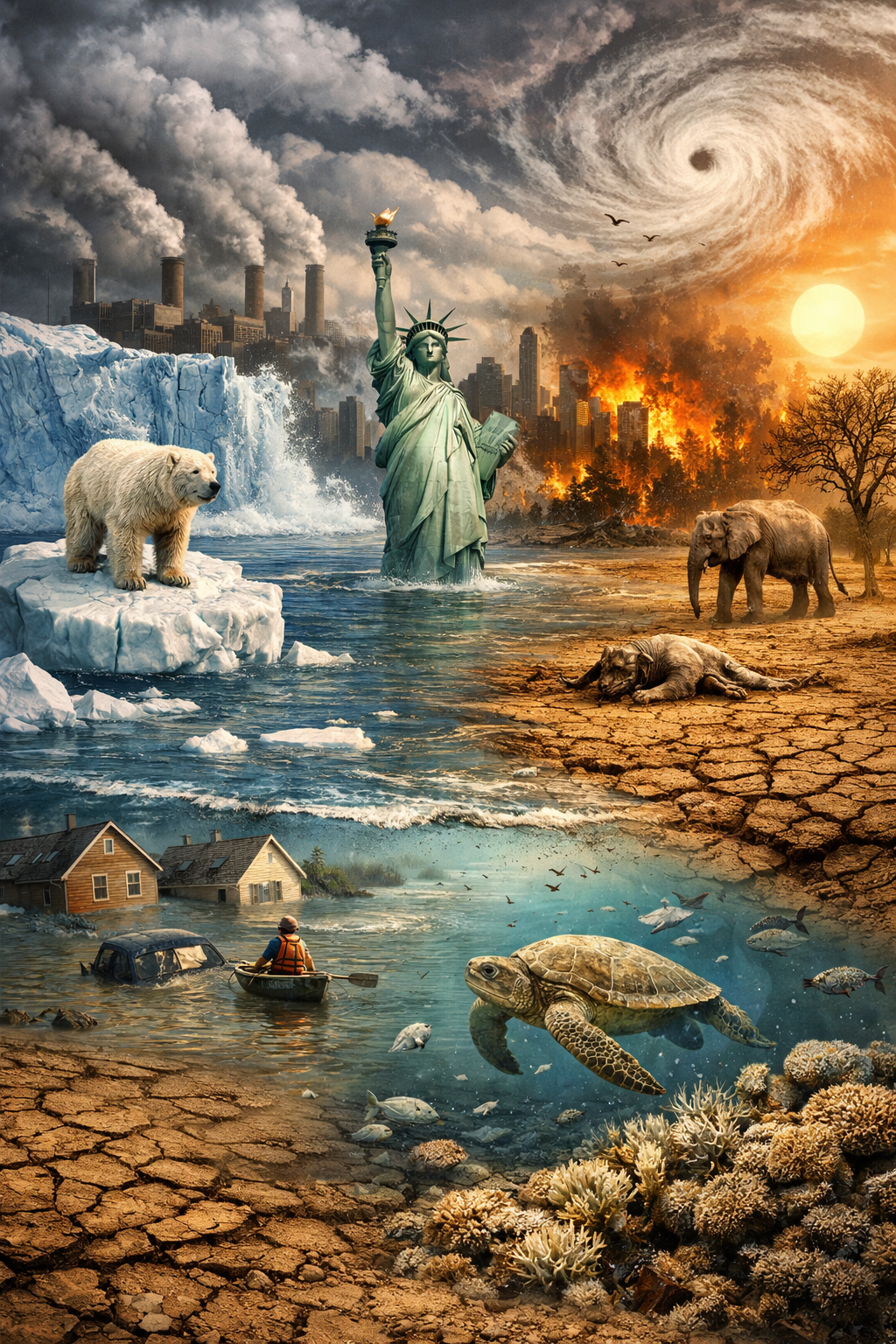
Global warming is the long-term rise in Earth’s average surface temperature due to the build up of greenhouse gases in the atmosphere. These gases trap heat from the sun, creating a warming effect that increases global temperatures over time.
Global warming is the sustained increase in Earth’s average surface temperature caused by rising concentrations of greenhouse gases such as carbon dioxide, methane, and nitrous oxide. The warming effect is primarily driven by human activities that release heat-trapping gases into the atmosphere.
Global Warming vs. Climate Change:
Global warming is a component of climate change, but the terms are not identical.
| Term | Meaning | Scope |
| Global warming | Increase in Earth’s average temperature | Temperature-focused |
| Climate change | Broad changes in climate patterns | Includes temperature, precipitation, extreme events |
(According to scientific consensus and climate science frameworks.)
The Greenhouse Effect:
The greenhouse effect is a natural process where greenhouse gases trap heat and keep Earth warm enough to support life.
How it works:
- Solar radiation reaches Earth
- Earth absorbs and re-emits heat
- Greenhouse gases trap some heat in the atmosphere
- Higher greenhouse gas concentrations increase trapped heat
This natural effect becomes harmful when human activity increases greenhouse gas levels, causing additional warming.
Facts:
- Global warming is the long-term rise in Earth’s average temperature.
- It is driven by increased greenhouse gas concentrations.
- Global warming is a subset of climate change.
- The greenhouse effect is the mechanism that traps heat.
Summary — What Global Warming Means:
Global warming refers to the long-term increase in Earth’s average surface temperature caused by higher greenhouse gas concentrations. It is a key driver of climate change and affects global weather patterns, ecosystems, and human systems.
Key Takeaways:
- Global warming is a measurable increase in global temperatures.
- It is caused by greenhouse gas accumulation.
- It is part of the broader climate change phenomenon.
What Causes Global Warming?
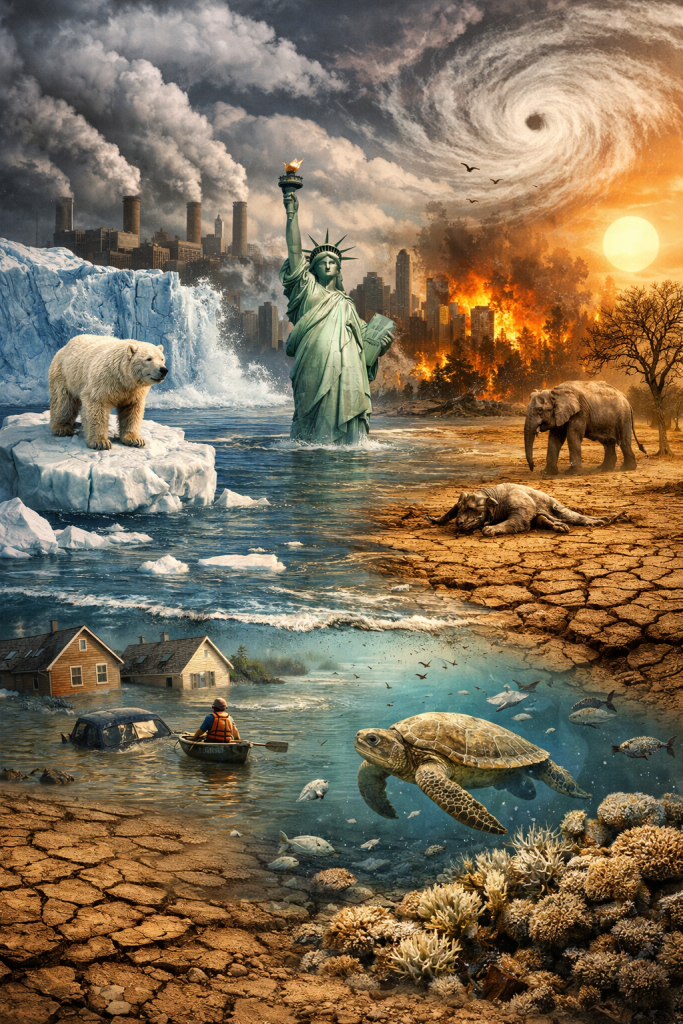
Greenhouse Gases and Their Role:
Global warming is primarily caused by increased concentrations of greenhouse gases (GHGs) in Earth’s atmosphere. These gases trap heat that would otherwise escape into space, leading to a gradual rise in global temperatures.
Major greenhouse gases include:
- Carbon dioxide (CO₂)
- Methane (CH₄)
- Nitrous oxide (N₂O)
- Fluorinated gases (F-gases)
Each gas has a different global warming potential (GWP) and atmospheric lifetime, meaning some gases warm the planet more strongly and for longer periods than others.
also read: Online Education [ 2026 ]
Fossil Fuel Combustion and Energy Production:
The largest source of greenhouse gas emissions is burning fossil fuels for energy.
Key sources include:
- Coal, oil, and natural gas combustion
- Electricity generation
- Industrial processes and manufacturing
- Transportation (vehicles, shipping, aviation)
Fossil fuel combustion releases large volumes of CO₂, which is the most abundant human-produced greenhouse gas.
Deforestation and Land-Use Change:
Deforestation and land-use change contribute to global warming by:
- Releasing stored carbon from trees and soil
- Reducing the planet’s capacity to absorb CO₂
- Altering local and regional climate patterns
Forests act as carbon sinks, and their removal reduces the natural balance of carbon storage.
Agriculture and Livestock:
Agriculture is a significant contributor to global warming through:
- Methane emissions from livestock digestion (enteric fermentation)
- Nitrous oxide emissions from fertilizer use
- Land conversion for farming
Livestock production and fertilizer-driven emissions are major sources of CH₄ and N₂O.
Industrial Processes:
Industrial activities contribute through:
- Production of cement and steel
- Chemical manufacturing
- Release of fluorinated gases used in refrigeration and industrial systems
These processes emit CO₂ and other greenhouse gases with high global warming potential.
Facts:
- Global warming is caused by increased greenhouse gas concentrations in the atmosphere.
- Carbon dioxide from fossil fuel combustion is the largest human-caused contributor.
- Methane and nitrous oxide from agriculture and land-use change contribute significant warming.
- Industrial processes and fluorinated gases increase warming due to high global warming potential.
Summary — Causes of Global Warming:
Global warming is driven by greenhouse gas emissions from fossil fuel combustion, deforestation, agriculture, and industrial processes. Human activities increase atmospheric concentrations of CO₂, CH₄, N₂O, and fluorinated gases, amplifying the natural greenhouse effect.
Key Takeaways:
- The greenhouse effect is intensified by human greenhouse gas emissions.
- CO₂ from fossil fuels is the largest contributor.
- Agriculture, land-use change, and industry also play major roles.
Evidence of Global Warming:
Global warming is supported by multiple independent lines of scientific evidence collected over decades through climate monitoring, satellite observations, and long-term data analysis.
Temperature Records and Trends:
Global average surface temperatures have risen over the past century, with the most rapid warming occurring since the mid-20th century.
Key evidence includes:
- Long-term temperature records from meteorological stations
- Satellite temperature measurements
- Temperature anomaly data showing consistent warming trends
These records show a clear upward trajectory in global temperature averages.
Ocean Warming and Heat Content:
Oceans absorb more than 90% of excess heat from global warming.
Evidence includes:
- Rising ocean heat content measured by oceanographic instruments
- Increasing sea surface temperatures
- Warmer deep ocean layers over time
Ocean warming contributes to marine ecosystem stress and thermal expansion of seawater.
Melting Ice and Glacier Retreat:
Widespread melting of ice is a major indicator of global warming.
Evidence includes:
- Declining Arctic sea ice extent
- Glacial retreat in mountain regions
- Shrinking ice sheets in Greenland and Antarctica
Reduced ice coverage affects albedo (reflectivity) and accelerates warming.
Sea Level Rise:
Sea level rise is driven by thermal expansion and ice melt.
Evidence includes:
- Tide gauge measurements showing long-term sea level rise
- Satellite altimetry data confirming global sea level increase
- Rising coastal water levels and increased flooding risk
Sea level rise is a measurable consequence of warming oceans and melting ice.
Increased Frequency of Extreme Weather:
Global warming is linked to changes in the frequency and intensity of certain extreme weather events.
Evidence includes:
- More frequent heatwaves and record-high temperatures
- Increased intensity of heavy rainfall events
- Rising frequency of intense tropical storms in some regions
Extreme weather trends are consistent with scientific projections of a warming climate.
Facts:
- Global warming is supported by temperature records, ocean heat content increases, and shrinking ice coverage.
- Sea level rise is measured by tide gauges and satellite altimetry, driven by thermal expansion and ice melt.
- Increased frequency of heatwaves and heavy rainfall events is linked to rising global temperatures.
- Multiple independent datasets confirm long-term warming trends.
Summary — Evidence of Global Warming:
Global warming is supported by temperature records, ocean warming, ice melt, sea level rise, and increased extreme weather events. These indicators consistently show a long-term trend of rising global temperatures.
Key Takeaways:
- Temperature records show a sustained warming trend.
- Oceans are warming and absorbing most excess heat.
- Ice melt and sea level rise are measurable consequences of warming.
- Extreme weather trends align with warming projections.
How Global Warming Affects the Planet:
Global warming alters Earth’s climate systems, causing measurable changes in ecosystems, weather patterns, and physical geography. These impacts are linked to temperature increases and changes in atmospheric and oceanic processes.
Ecosystem Disruption:
Rising temperatures affect ecosystems by changing habitats, migration patterns, and species survival.
Examples of ecosystem impacts:
- Shifts in plant and animal ranges toward higher altitudes or latitudes
- Coral bleaching due to warmer ocean temperatures
- Loss of biodiversity and increased extinction risk for vulnerable species
Ecosystem disruption affects food chains, ecosystem services, and overall biodiversity.
Ocean Acidification:
Ocean acidification occurs when oceans absorb carbon dioxide (CO₂) from the atmosphere, forming carbonic acid and lowering seawater pH.
Key effects include:
- Reduced ability for shell-forming organisms (e.g., corals, mollusks) to build skeletons
- Disruption of marine food webs
- Increased vulnerability of coral reef ecosystems
Ocean acidification is a direct consequence of elevated atmospheric CO₂ levels.
Shifts in Precipitation Patterns:
Global warming changes rainfall distribution, leading to uneven precipitation trends across regions.
Common precipitation impacts:
- Increased rainfall intensity in some regions
- Longer and more severe droughts in others
- Altered seasonal rainfall timing affecting agriculture and water supplies
These changes can increase flood risk in some areas while worsening water scarcity in others.
Biodiversity Loss:
Rising temperatures and habitat disruption contribute to biodiversity loss.
Contributing factors include:
- Habitat degradation and fragmentation
- Reduced food and water availability
- Increased stress on species unable to adapt quickly
Biodiversity loss can reduce ecosystem resilience and decrease natural resource availability.
Feedback Loops (Permafrost, Albedo Effect):
Feedback loops accelerate warming by amplifying the effects of temperature increases.
Common feedback mechanisms:
- Permafrost thaw: releases stored methane and CO₂
- Albedo effect: melting ice reduces reflectivity, causing more heat absorption
- Forest dieback: reduces carbon uptake and increases CO₂ in the atmosphere
Feedback loops can increase the pace of warming beyond initial projections.
Summary — Planetary Impacts of Global Warming:
Global warming affects ecosystems, oceans, precipitation patterns, and biodiversity. Feedback loops such as permafrost thaw and reduced albedo can accelerate warming and amplify impacts.
Key Takeaways:
- Ecosystems and species are shifting due to rising temperatures.
- Ocean acidification threatens marine life and food webs.
- Changes in precipitation increase flood and drought risks.
- Feedback loops can accelerate global warming.
Global Warming and Human Health:
Global warming affects human health directly through temperature increases and indirectly through environmental, social, and economic changes. Health impacts vary by region, population vulnerability, and the ability of healthcare systems to respond.
Heat-Related Illnesses:
Rising temperatures increase the frequency and intensity of heatwaves, leading to heat-related health risks.
Common heat-related impacts include:
- Heat exhaustion and heatstroke
- Increased dehydration and electrolyte imbalance
- Higher risk for elderly, infants, and people with chronic illness
Heatwaves can also worsen cardiovascular and respiratory conditions.
Vector-Borne Diseases:
Changes in temperature and precipitation patterns influence the distribution of disease-carrying insects.
Examples of vector-borne disease impacts:
- Expanded range of mosquitoes that transmit dengue, malaria, and Zika
- Increased tick populations and spread of Lyme disease
- Higher risk of waterborne disease outbreaks after flooding
Warmer conditions can lengthen transmission seasons and increase disease incidence.
Food and Water Insecurity:
Global warming affects food production and water availability through droughts, heat stress, and shifting rainfall.
Health impacts include:
- Reduced crop yields and nutritional quality
- Increased risk of malnutrition and food scarcity
- Water shortages and reduced access to clean water
- Higher risk of water contamination during floods
Food and water insecurity can increase disease burden and mortality.
Air Quality Impacts:
Global warming affects air quality by increasing pollutants and allergens.
Key air quality impacts include:
- Higher ground-level ozone concentrations
- Increased wildfire frequency and smoke exposure
- Longer pollen seasons and higher allergen levels
Poor air quality can worsen asthma, COPD, and other respiratory conditions.
Summary — Health Impacts of Global Warming:
Global warming affects health through heat-related illnesses, vector-borne diseases, food and water insecurity, and worsening air quality. These impacts increase disease burden and strain health systems, especially in vulnerable communities.
Key Takeaways:
- Heatwaves increase risk of heat-related illness and mortality.
- Climate-driven changes expand the range of disease vectors.
- Food and water insecurity can increase malnutrition and disease.
- Air quality deterioration contributes to respiratory and cardiovascular problems
Mitigation: Reducing Global Warming:
Mitigation refers to actions that reduce greenhouse gas emissions or remove carbon from the atmosphere, aiming to slow or stop global warming. Mitigation strategies are implemented at global, national, and local levels across energy, industry, transportation, and land use.
Renewable Energy Adoption:
Replacing fossil fuels with renewable energy reduces carbon dioxide emissions from electricity and heat production.
Common renewable energy sources:
- Solar power
- Wind power
- Hydropower
- Geothermal energy
Renewables generate electricity with low or zero direct greenhouse gas emissions.
Energy Efficiency:
Energy efficiency reduces emissions by lowering energy consumption for the same level of service.
Examples include:
- Improved building insulation and efficient heating/cooling systems
- Efficient industrial processes and equipment
- Energy-efficient lighting and appliances
- Better transportation efficiency (fuel-efficient vehicles, electrification)
Energy efficiency can reduce demand and lower overall energy costs.
Carbon Capture and Storage (CCS):
Carbon capture and storage involves capturing CO₂ emissions from power plants or industrial sources and storing them underground.
CCS components include:
- CO₂ capture technology
- Transportation (pipelines or transport systems)
- Storage in geological formations
CCS is used in industries where emissions are difficult to eliminate, such as cement and steel production.
Reforestation and Land Restoration:
Restoring forests and ecosystems increases carbon sequestration, removing CO₂ from the atmosphere.
Examples include:
- Reforestation and afforestation
- Wetland restoration
- Sustainable land management practices
- Soil carbon storage through regenerative agriculture
Land restoration contributes to both climate mitigation and biodiversity protection.
Transportation Emissions Reduction:
Reducing emissions from transportation involves shifting to low-carbon options and improving systems.
Key strategies:
- Electrification of vehicles
- Public transit expansion
- Improved fuel standards and efficiency
- Reduced reliance on fossil fuel-based transportation
Transportation is a major source of CO₂ emissions in many countries.
Summary — Mitigation Strategies:
Mitigation actions reduce greenhouse gas emissions and increase carbon removal through renewable energy, energy efficiency, carbon capture, land restoration, and transportation decarbonization.
Key Takeaways:
- Renewable energy and energy efficiency lower emissions from power and buildings.
- Carbon capture helps reduce emissions from hard-to-decarbonize industries.
- Reforestation and land restoration remove CO₂ from the atmosphere.
- Transportation decarbonization is critical to reducing global emissions.
Adaptation: Preparing for Global Warming:
Adaptation involves actions that reduce the harm caused by global warming and increase resilience to climate impacts. Unlike mitigation, which focuses on lowering emissions, adaptation prepares communities, infrastructure, and ecosystems for ongoing and future climate changes.
Climate-Resilient Infrastructure:
Climate-resilient infrastructure is designed to withstand climate-related stress such as heat, flooding, and storms.
Examples include:
- Flood-resistant buildings and elevated structures
- Heat-resilient materials for roads and bridges
- Improved drainage and stormwater systems
- Coastal defenses such as sea walls and natural barriers
Resilient infrastructure reduces damage costs and improves long-term stability.
Disaster Preparedness and Early Warning Systems:
Disaster preparedness includes planning and systems that reduce harm during extreme weather events.
Common adaptation measures:
- Early warning systems for heatwaves, storms, and floods
- Emergency response planning and evacuation protocols
- Community education and preparedness training
- Strengthened disaster response infrastructure
Early warning systems reduce mortality and improve emergency response effectiveness.
Water Resource Management:
Water management adaptation strategies address droughts, floods, and changing precipitation patterns.
Examples include:
- Improved water storage and reservoir systems
- Efficient irrigation and water-use practices
- Watershed protection and restoration
- Desalination and water recycling where appropriate
Effective water management supports agriculture, public health, and ecosystems.
Agriculture Adaptation Strategies:
Adaptation in agriculture aims to maintain food production under changing climate conditions.
Key strategies include:
- Drought-resistant crop varieties
- Climate-smart farming practices
- Adjusted planting schedules and crop diversification
- Improved soil management and irrigation efficiency
Agriculture adaptation helps reduce food insecurity risks linked to global warming.
Summary — Adaptation Strategies:
Adaptation actions reduce vulnerability to climate impacts through resilient infrastructure, disaster preparedness, water management, and agricultural adaptation. Adaptation helps communities maintain safety, food security, and economic stability as the climate changes.
Key Takeaways:
- Adaptation focuses on resilience to climate impacts.
- Infrastructure and disaster preparedness reduce harm from extreme weather.
- Water and agriculture adaptation support food and water security.
- Adaptation is essential alongside mitigation to address ongoing warming.
Global Policy and Agreements:
Global warming is addressed through international cooperation, scientific assessment, and policy frameworks that set targets, measure progress, and guide national actions. These systems aim to reduce emissions and build resilience across countries.
IPCC and Scientific Reporting:
The Intergovernmental Panel on Climate Change (IPCC) is the leading international body that assesses climate science.
IPCC functions include:
- Reviewing scientific literature on climate change
- Producing assessment reports on climate science, impacts, and mitigation
- Providing scenario-based projections of future warming
IPCC reports are used to inform policy decisions and global climate negotiations.
Paris Agreement Goals:
The Paris Agreement is a global treaty adopted to limit global temperature rise.
Core objectives include:
- Limiting warming to well below 2°C above pre-industrial levels
- Pursuing efforts to limit warming to 1.5°C
- Strengthening national commitments through periodic updates
The agreement relies on national pledges and international cooperation.
Nationally Determined Contributions (NDCs):
NDCs are country-specific climate action plans submitted under the Paris Agreement.
NDC characteristics include:
- Emissions reduction targets
- Timelines and policy measures
- Updates every 5 years to increase ambition
NDCs are a primary mechanism for tracking national climate commitments.
Carbon Pricing and Regulation:
Carbon pricing is a policy tool used to reduce greenhouse gas emissions by creating economic incentives.
Common approaches:
- Carbon taxes (price per ton of CO₂ emitted)
- Cap-and-trade systems (emission limits with tradable permits)
Carbon pricing aims to make high-emission activities more expensive and encourage low-carbon alternatives.
Summary — Global Climate Policy Frameworks:
Global warming is addressed through international agreements and scientific guidance, including the IPCC assessment reports, the Paris Agreement, national NDCs, and carbon pricing policies. These frameworks coordinate global action and track progress toward temperature goals.
Key Takeaways
- The IPCC provides scientific assessment and projections.
- The Paris Agreement sets global temperature targets.
- NDCs outline national commitments and policies.
- Carbon pricing encourages emissions reduction through economic incentives.
Common Misconceptions About Global Warming:
Global warming is often misunderstood due to misinformation, confusion with weather variability, and simplified narratives. Correcting these misconceptions supports accurate public understanding and informed decision-making.
“Global warming isn’t real”:
Global warming is supported by multiple independent datasets showing long-term temperature increases, rising ocean heat content, melting ice, and sea level rise. These indicators collectively confirm a sustained warming trend.
“It’s just natural climate cycles”:
While natural climate cycles exist, the current rate and magnitude of warming are strongly linked to human-caused greenhouse gas emissions. Scientific assessments attribute most recent warming to anthropogenic factors rather than natural variability.
“Climate change and global warming are the same thing”:
Global warming refers specifically to rising average global temperatures. Climate change includes broader changes in climate patterns such as precipitation shifts, extreme weather, and regional climate variability.
“Renewables can’t replace fossil fuels”:
Renewable energy technologies (solar, wind, hydropower, geothermal) are increasingly cost-competitive and scalable. Many countries are expanding renewable capacity while reducing fossil fuel dependence through grid upgrades and energy storage.
“Individual actions don’t matter”:
Individual actions alone cannot solve global warming, but they contribute to emission reductions and signal demand for cleaner energy. Collective behavior change, combined with policy and corporate action, supports large-scale emissions reductions.
Summary — Common Misconceptions:
Common misconceptions about global warming include denying its existence, confusing it with natural cycles, equating it with climate change, and underestimating renewable energy or individual impact. Correcting these misconceptions is important for accurate understanding and effective action.
Key Takeaways
- Global warming is scientifically supported by long-term data.
- Human activity is the primary driver of recent warming.
- Global warming and climate change are related but not identical.
- Renewable energy is a viable path to reducing emissions
Conclusion:
Global warming is the long-term increase in Earth’s average surface temperature driven primarily by human activities that raise greenhouse gas concentrations. Evidence from temperature records, ocean warming, melting ice, and sea level rise confirms a sustained warming trend. The impacts of global warming are broad, affecting ecosystems, weather patterns, oceans, and human health. Addressing global warming requires both mitigation strategies that reduce emissions and adaptation measures that strengthen resilience to climate impacts. International agreements such as the Paris Agreement and scientific assessments by the IPCC guide global action and policy development. Understanding the causes, evidence, impacts, and solutions is essential for informed decision-making and collective action.
FAQs:
1. What is global warming?
Global warming is the long-term increase in Earth’s average surface temperature caused by rising greenhouse gas concentrations in the atmosphere.
2. What causes global warming?
Global warming is primarily caused by greenhouse gas emissions from fossil fuel combustion, deforestation, agriculture, and industrial processes.
3. How do we know global warming is happening?
Global warming is confirmed through multiple lines of evidence including temperature records, ocean heat measurements, melting ice and glaciers, sea level rise, and changes in extreme weather patterns.
4. What is the difference between global warming and climate change?
Global warming refers specifically to rising global temperatures, while climate change includes broader shifts in climate patterns such as precipitation changes and extreme weather events.
5. What are the main effects of global warming?
Global warming impacts ecosystems, increases sea levels, alters precipitation patterns, causes biodiversity loss, and affects human health through heatwaves, disease spread, and food and water insecurity.
6. What is mitigation in global warming?
Mitigation refers to actions that reduce greenhouse gas emissions or remove carbon from the atmosphere, such as renewable energy, energy efficiency, and reforestation.
7. What is adaptation to global warming?
Adaptation involves preparing for and reducing the impacts of global warming through measures such as climate-resilient infrastructure, disaster preparedness, water management, and agricultural adaptation.
References:
- Intergovernmental Panel on Climate Change (IPCC) — Assessment reports and scientific findings on climate change and global warming
- United Nations Framework Convention on Climate Change (UNFCCC) — Paris Agreement and national climate commitments
- National Aeronautics and Space Administration (NASA) — Global temperature records and climate data
- National Oceanic and Atmospheric Administration (NOAA) — Climate monitoring and ocean heat content data
- World Meteorological Organization (WMO) — Climate reports and global climate indicators
- United Nations Environment Programme (UNEP) — Climate mitigation and adaptation policy guidance.